• Home
  • What We Do
  • About
  • Employee Benefits
  • Individual Info
  • Health Care Reform
  • Kudos
  • Blog
  • Contact

GoGetCovered.com

We help make getting covered easier! - Insurance for Businesses and Individuals

GoGetCovered: Insurance for Businesses and Individuals
  • Group Health
    • Large Group Health Insurance
    • Small Group Health Insurance
  • Group Life
  • Group Dental
  • Vision
  • Short Term
  • Disability
  • Individual/Family
  • Children
  • Travel

When can I make an election change to my FSA? To my HSA?

April 4, 2018

There are many common misconceptions regarding election changes when it comes to pre-tax benefit accounts. In fact, 1 in 3 people understands when an election change can occur for a health savings account. (HINT: It is more often than you might realize.) This is understandable given that flexible spending accounts have been available longer and are likely shaping people’s opinions regarding HSAs. With open enrollment in full swing for many people, it is an important time to break these misconceptions down. Let’s start by looking at the basics of an election change.

The Basic Rules of FSA and HSA Election Changes

Flexible Spending Accounts: An FSA election change can occur at open enrollment each year or when a qualifying event has occurred (if permitted by the employer). The IRS specifies that election changes during the plan year must be consistent with the eligible change in status. All changes must follow IRS guidelines and generally require supporting documentation of the event. The most common qualifying events include:

  • Change in marital status (such as marriage, divorce or death of a spouse)
  • Birth / adoption of a child
  • Change in employment affecting eligibility or coverage
  • Change in residence or change in cost of coverage (restricted to Dependent Care FSA changes)

Health Savings Accounts: An HSA election change can occur at any time, for any reason. An employer may limit changes to once per month for administrative purposes. However, there are no other restrictions on changing your pre-tax HSA elections.

Applying the Basic Rules for an Election Change

With a clear understanding of the basic rules, let’s run through a few scenarios. We’ll start with a few easy ones and move on to some more complicated scenarios.


Scenario #1: It’s open enrollment

Impact to FSA election: Follow your employer’s process to enroll in the FSA. Be sure to enroll prior to the end of the open enrollment period. You will need to actively make an FSA election each plan year. This is your main opportunity to start or stop an election, and increase or decrease an election.

Impact to HSA election: Follow your employer’s process to enroll in the HSA. If you already have an HSA with your employer’s preferred HSA partner, you will not need to enroll each year. Be sure you understand the process your employer is using to fund and set HSA pre-tax contribution amounts. If your employer is using direct deposit to fund the HSA, you may have a rolling election, which is only changed when it is requested. Your employer may however use open enrollment as an opportunity for all HSA eligible employees to update and change their elections. In this case, you may need to actively select an HSA pre-tax contribution amount in order to continue contributing in the new plan year. HSA limits are set by the IRS each year.

Scenario #2: I just got married.

Impact to FSA election: Notify your employer of your change in marital status as soon as possible. There is a limited time period from the event in which you are eligible for a mid-year election change. When getting married, you are eligible to INCREASE your FSA election.

Impact to HSA election: Make changes at any time!


Scenario #3: I had a baby.

Impact to FSA election: Notify your employer of the birth of your child. The birth of a child (or the date of adoption) allows you to INCREASE or START a Medical FSA election and/or a Dependent Care FSA election. Confirm with your employer on any limitations that may apply.

Impact to HSA election: Make changes at any time!


Scenario #4: My spouse changed jobs and I am starting benefits with my employer.

Impact to FSA election: Notify your employer of your qualifying event and follow the steps to enroll in the FSA.

Impact to HSA election: Make changes at any time!


Scenario #5: I moved and will no longer need child care services for my eligible dependent.

Impact to FSA election: Notify your employer of the change of address and change in child care expense. Follow the steps outlined by your employer to stop your active Dependent Care FSA election. However, moving is not generally a qualify event for purposes of a Medical FSA. Therefore, changes would not be permitted to your Medical FSA.

Impact to HSA election: There is no direct impact to an HSA. However, there is also no restriction against changes. If you no longer have a child care expense, that is a great time to consider increasing your HSA election.


Scenario #6: My employer is changing health plans mid-year, but the FSA is on a calendar year.

Impact to FSA election: A change in health plan is not a qualifying event. If you are already enrolled in a Medical FSA, you would continue with your existing election through the end of the FSA plan year.

Impact to HSA election: If you select an HSA-qualifying health plan and are still covered by a Medical FSA, you are not eligible to contribute to an HSA until after the FSA plan year ends. If you are changing health plans and will no longer by covered by an HSA-qualified health plan, you will need to determine your prorated HSA contribution amount for the year and may need to stop contributions.


When in doubt…tips to consider

As you can see, these are just a few scenarios affecting an election change. It can be complicated. Remember these few tips the next time you consider changing your FSA or HSA election.

  • TIP #1: PLAN FOR THE EXPECTED WHEN IT COMES TO FSA ELECTIONS.  Consider what lies ahead in the coming year. When possible, factor situations that are known into your initial FSA election.
  • TIP #2: FSA ELECTION CHANGES NEED TO BE CONSISTENT WITH THE STATUS CHANGE—This is the tricky part. When you have a qualifying event, the election change must also be consistent with the impact of the qualifying event. So, if your family gets bigger, you can increase elections. If your family gets smaller, you may be eligible to decrease an election. Note: Employers may restrict mid-year election changes.
  • TIP #3: AS LONG AS YOU ARE HSA ELIGIBLE, HSA CHANGES CAN BE MADE. Determining when you are eligible to contribute to an HSA can sometimes be complicated. Everything else is pretty simple. HSA election changes can be made at any time, for any reason.
  • TIP #4: When in doubt, seek advice.

Filed Under: Flexible Spending Accounts, Health Savings Accounts

How 50+ Benefits Correlate with Employee Satisfaction

April 4, 2018

Glassdoor Economic Research explored the best industries for benefits and which benefits drive employee satisfaction. In both studies, we restricted the benefits we examined to those we had the most data for in order to rigorously study them: health insurance, vacation/paid time off, 401(k) plans, maternity/paternity leave, employee discounts and free food.

However, Glassdoor’s Benefits Reviews survey collects data on many more types of benefits. Employees can rate and review more than 50 distinct employer-provided benefits, while employers can verify the benefits they offer, providing a well-rounded picture what’s offered at hundreds of thousands of companies. The survey covers a wide variety of workplace benefits and perks, including pet-friendly workplaces, employee adoption assistance, travel concierge services, company cars, mobile phone discounts and more.

To dig deeper, we wanted to understand which of these 50+ perks and benefits matter most to employees.

One simple way to do so is to show the statistical correlation between individual benefits ratings (on a scale of 1 to 5) and how employees rate their overall satisfaction with benefits packages (again, on a 1 to 5 scale).

The table below shows the full list of correlations between 54 benefits tracked by Glassdoor and overall employee satisfaction with benefits packages. The correlations range between zero and one. A correlation near one means the benefit is a good predictor of employee satisfaction with overall benefits packages, while a correlation near zero means the benefit has little impact on employee satisfaction. In other words, which benefits are more important to employees and which are less important?

GD_54_BenefitsRanking

Overall, the above results echo the findings of our earlier study: The core benefits that matter most to workers are health insurance, vacation and paid time off, and retirement plans. These core benefits are most highly correlated with employee satisfaction with benefits packages.

At the bottom of the list, we see less common benefits like fertility assistance, employer-provided child care, and travel concierge services. These benefits have almost no correlation at all with employee satisfaction. While they may be quite valuable to some employees, the data suggest most workers place a low value on these benefits.

Interestingly, many headline-catching benefits such as pet-friendly workplaces, reduced and flexible hours, and gym memberships rank near the bottom of this list in terms of correlation with employee satisfaction. Even the much-discussed benefit of free lunch and snacks ranked 16th out of 54 benefits, well behind more prosaic and traditional benefits like retirement plans.

Although the above correlations are interesting, some caution is warranted in interpreting these findings. These are just simple correlations between benefit ratings, and don’t statistically control for factors like company size or industry as in our previous, more rigorous analysis of Glassdoor benefits ratings.

Despite these limitations, the lesson of the above table is clear. While less common benefits tend to dominate media coverage, employers should not neglect core benefits such as health insurance and paid time off. The data clearly show these benefits—while less exciting than many of today’s flashy workplace perks—are still the main drivers of employee satisfaction.

For employers looking to win top talent, providing a well-rounded total compensation package that includes core benefits, fair pay and desirable perks will help them compete in a challenging hiring landscape.

Filed Under: Benefit News, Flexible Spending Accounts, Health Savings Accounts

Adjusted 2018 HSA Limits Announced

April 3, 2018

UPDATED MARCH 5, 2018. The IRS released Internal Revenue Bulletin 2018-10 indicating changes to the 2018 HSA Family contribution maximum. The family contribution maximum is being adjusted downward to $6,850 (from the previously announced limit of $6,900). This change may affect current and future contributions to HSAs. Please make any necessary adjustments to future contributions to accommodate the change. If you have already fully contributed for 2018, you may need to initiate an excess contribution removal. 

The IRS initially released the 2018 cost-of-living adjustments for Health Savings Accounts (HSAs) in May 2017. However, the passing of the Tax Reform Bill led to a recalculation of the limits. HSAs are subject to annual adjustments. HSA limits consist of the contribution limits, minimum deductible requirements and maximum out-of-pocket limits.

2018 HSA Contribution Limit

The HSA limits for contributions are set to increase in 2018. Individuals age 55 or older can continue to make an additional $1,000 catch-up contribution.

Individual: $3,450 (up from $3,400 in 2017)

Family: $6,850 (up from $6,750 in 2017)

HSA HDHP Requirements

The minimum deductible requirements are set to increase in 2018. For employers and individuals that are currently in a plan set at or near the minimum deductible limits, you will need to make adjustments to ensure your plan continues to remain HSA eligible.

Individual:
$1,350 minimum deductible (up from $1,300)
$6,650 maximum out-of-pocket (up from $6,550)

Family:
$2,700 minimum deductible (up from $2,600)
$13,300 maximum out-of-pocket (up from $13,100)

For individuals following the American Health Care Act, a bill has passed the House of Representatives and is up for consideration in the Senate.  If the American Health Care Act became law, it would further expand these limits and make HSAs more flexible.

Filed Under: Health Savings Accounts, Taxes

2017 HSA Changes and Out of Pocket Maximum Updates

August 2, 2016

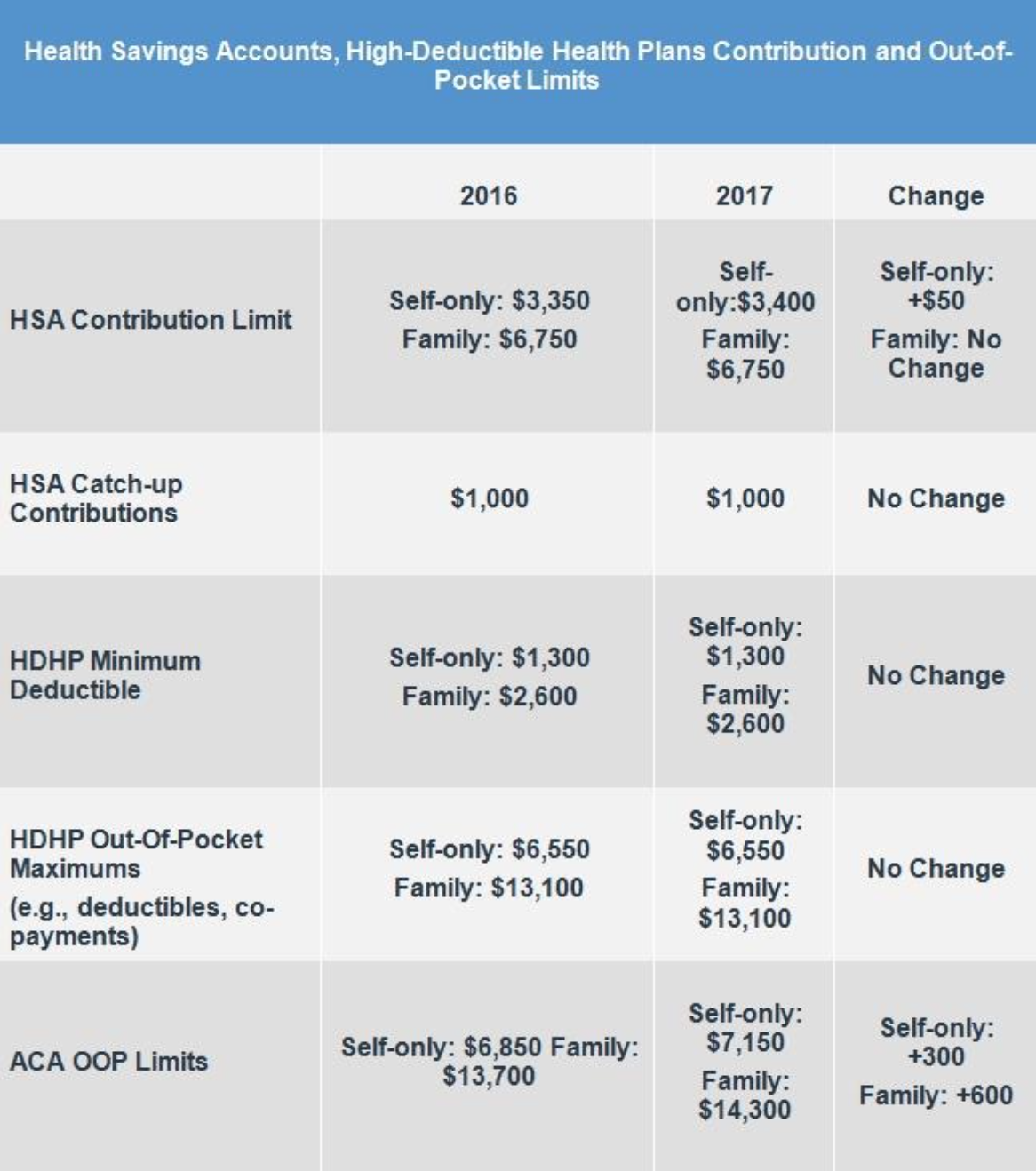
The Internal Revenue Service (IRS) recently released the inflationary adjustments for 2017 High-Deductible Health Plan (HDHP) and Health Savings Account (HSA) plans. Generally, the limits for 2016 and 2017 will remain the same, with the exception of the self-only HSA maximum contribution limit.

The Affordable Care Act (ACA) Out-Of-Pocket (OOP) and cost-sharing limits are other threshold amounts employers should be aware of; those limits are adjusted by the Department of Health and Human Services (HHS). These limits may differ slightly from each other (i.e., the ACA cost-sharing limit is higher than the OOP for HDHPs). In order for a plan to qualify as an HDHP, it must comply with the lower OOP maximum limit. (For 2017 that limit is $6,550 for self-only and $13,100 for family plans, but keep in mind that individual deductibles must be embedded, meaning each individual covered on a family HDHP can only be required to meet the self-only deductible).

Employers with an HDHP and an HSA should ensure their plans are compliant with the new limits by the first day of their plan year in 2017.

table comparing 2016 and 2017: Health Savings Accounts, High-Deductible Health Plans Contribution and Out-of-Pocket Limits

Filed Under: Affordable Care Act, Health Savings Accounts, Taxes

  • « Previous Page
  • 1
  • 2
  • 3
Phone Us: 303-377-1399

Search GoGetCovered.com

Our Insurance Providers:

Join us on social media


Recent Updates

  • ONE BIG BEAUTIFUL BILL ACT – Here’s what you need to know
  • 2025 Contribution Limits – Updates
  • IRS Contribution Limits (What’s changing in January 2025)
  • IRS Contribution Limits (2024 Update)
  • IRS Releases 2024 Limits for HSAs, EBHRAs & HDHPs
  • 2022 Year-End Compliance Review
  • IRS Regulations Fix the ACA’s Family Glitch as of 2023
  • Health Plan Prescription Drug Reporting Mandate (RxDC)
  • IRS Releases 2023 Limits for Flexible Spending Accounts (FSA), Health Savings Accounts (HSA) and Commuter Benefits
  • Inflation Reduction Act to be Signed into Law, Includes Multiple Medicare Drug Pricing Reforms

site map · privacy policy · Copyright © 2026 · Cheryl Golenda Insurance Agency Inc. · theme by StudioPress · customized by Intent Design Studio · hosted by BlueHost · Log in

This website uses cookies to improve your experience. We'll assume you're ok with this, but you can opt-out if you wish. Cookie settingsACCEPT
Privacy & Cookies Policy

Privacy Overview

This website uses cookies to improve your experience while you navigate through the website. Out of these cookies, the cookies that are categorized as necessary are stored on your browser as they are as essential for the working of basic functionalities of the website. We also use third-party cookies that help us analyze and understand how you use this website. These cookies will be stored in your browser only with your consent. You also have the option to opt-out of these cookies. But opting out of some of these cookies may have an effect on your browsing experience.
Necessary
Always Enabled
Necessary cookies are absolutely essential for the website to function properly. This category only includes cookies that ensures basic functionalities and security features of the website. These cookies do not store any personal information.
SAVE & ACCEPT