
• Home
  • What We Do
  • About
  • Employee Benefits
  • Individual Info
  • Health Care Reform
  • Kudos
  • Blog
  • Contact

GoGetCovered.com

We help make getting covered easier! - Insurance for Businesses and Individuals

GoGetCovered: Insurance for Businesses and Individuals
  • Group Health
    • Large Group Health Insurance
    • Small Group Health Insurance
  • Group Life
  • Group Dental
  • Vision
  • Short Term
  • Disability
  • Individual/Family
  • Children
  • Travel

ONE BIG BEAUTIFUL BILL ACT – Here’s what you need to know

August 25, 2025

ONE BIG BEAUTIFUL BILL ACT – Here’s what you need to know

On July 4, 2025, President Trump signed the One Big Beautiful Bill Act (OBBBA) into law. This landmark legislation introduced sweeping changes to employer-sponsored benefits, most notably affecting Health Savings Accounts (HSAs), Dependent Care Flexible Spending Accounts (FSAs), and student loan assistance programs.

This communication provides an overview of four changes related to the OBBBA to keep you updated:

Dependent Care FSA – Increased Annual Contribution Limit

The OBBBA includes legislation that allows Plan Sponsors to increase the annual employee contribution limit in a Dependent Care FSA (DCFSA) plan from $5,000 to $7,500 (or $3,750 each for married couples filing separately) starting with tax year 2026, the first change since the rates were set in 1986. This allowable election amount is available on top of any carried over funds from the 2025 plan year.
This increase aims to help working families manage the rising cost of childcare and other dependent care needs and also promises to benefit employers; with more allowable pretax plan contributions, employers increase the potential for more FICA savings while employees increase their tax savings on childcare expenses they already pay. This is expected to have several positive impacts, including:
• Increased access to affordable childcare. The expanded tax benefits and credits could make childcare more affordable for many families, especially those with lower incomes.
• Support for workforce participation. By reducing the financial burden of childcare, these measures may encourage parents to enter or remain in the workforce, potentially leading to improved family financial stability.
• Potential for improved health and developmental outcomes. Studies have shown a strong link between access to affordable, high-quality childcare and positive health and developmental outcomes for children, including better academic achievement, social skills, and long-term health, according to the National Institutes of Health.

• Reduced maternal depressive symptoms. Research suggests that access to affordable childcare can protect mothers from depressive symptoms and buffer children from negative emotional and behavioral impacts associated with maternal mental health disorders, according to the Policy Center for Maternal Mental Health.

Health Savings Accounts

The OBBBA incorporated three expansions to HSAs, greatly expand eligibility and flexibility. The OBBBA provisions align with the broader trend of consumer-driven healthcare, where individuals are empowered to manage their healthcare spending through savings tools like HSAs.
• Telehealth coverage. Allows High Deductible Health Plans (HDHPs) to provide first-dollar telehealth and other remote care services without disqualifying HSA contributions. This change is effective retroactively for plan years beginning after December 31, 2024.
• Bronze and Catastrophic Plans available on Exchange as HDHPs. Beginning in 2026, the OBBBA will treat all Bronze and catastrophic plans that are available on an ACA exchange as qualified HSA plans. This is a significant change that will allow individuals covered under these plans to enroll in and contribute to an HSA.
• Direct Primary Care (DPC). The OBBBA, as of 2026, will treat DPC as a health plan that does not disqualify an individual from contributing to an HSA, provided that the fees do not exceed $150 per month for individuals or $300 per month for multiple covered individuals. DPC service arrangements will qualify as an HSA-eligible medical expense, limited to $150 per month for individuals or $300 per month for multiple covered individuals, indexed for inflation.

Student Loan Repayment

The Student Loan Repayment amount of $5,250 annual non-taxable benefit for employer-sponsored student loan assistance is now permanent and will adjust for inflation. Other legislative changes in the OBBBA reduce the role of the federal government in funding higher education, leaving students to look for alternative ways to pay; this makes student loan benefits a more viable long-term component of compensation and hiring strategies.

Tax-Free Bicycle Commuting

The OBBBA permanently eliminated the tax-free bicycle commuter benefit account. This exclusion had been temporarily suspended since 2018.

Cheryl Golenda – GoGetCovered –720.273.2880

750 kearney street – denver co  80220

GoGetCovered.com – facebook – linkedin 
Filed Under: Uncategorized

2025 Contribution Limits – Updates

October 22, 2024

The IRS has announced the 2025 contribution limits for flexible spending accounts (FSA), commuter benefits, and more. Here’s a look at what’s changing:

  • Health FSA: $3,300 (Increased from $3,200).
  • FSA Rollover: $660 (Increased from $640).
  • Commuter (Parking and Transit): $325 per month (Increased from $315).
  • Dependent Care: The annual limits will remain $5,000 for single taxpayers and married couples filing jointly or $2,500 for married people filing separately.
  • Qualified Small Employer HRA: $6,350 for individuals and $12,800 for families.
  • HSA Limits (Announced Previously): $4,300 for individuals and $8,550 for families.
  • PCORI fee adjustment: 2025 Fee Not Yet Announced

Filed Under: Announcements, Flexible Spending Accounts

IRS Contribution Limits (What’s changing in January 2025)

May 18, 2024

Each year the IRS announces updates to contribution limits for Flexible Spending Accounts (FSA), Health Savings Accounts (HSA), Health Reimbursement Arrangements (HRA), and other tax-advantaged accounts. Here’s a look at what’s changing in January 2025.

Contribution Limits20242025
Health FSA: Max Contribution Limit$3,200-
Health FSA: Rollover Max$640-
DCFSA: Max Contribution Limit$2,500/$5,000-
HSA: Max Contribution Limit$4,150 Self-Only
$8,300 Family
$4,300 Self-Only
$8,550 Family
HSA: Catch-Up Contribution Limit$1000$1000
HSA: HDHP Out-of-Pocket Max$8,050 Self-Only
$16,100 Family
$8,300 Self-Only
$16,600 Family
HSA: HDHP Minimum Annual Deductible$1,600 Self-Only
$3,200 Family
$1,650 Self-Only
$3,300 Family
Commuter Reimbursement: Parking$315/month-
Commuter Reimbursement: Transit $315/month-
QSEHRA$6,150 Single
$12,450 Family
-
EBHRA$2,100$2,150
Educational Assistance – Max Income Exclusion$5,250-
Medical Mileage Rate$.21-
Highly Compensated Employee Dollar Threshold$155,000-
Key Employee Dollar Threshold$220,000-

Health Savings Account (HSA) contribution increases:

Significant contribution increases will allow employees to save more with their HSAs next year. The increases will take effect in January 2025 and are outlined in more detail in this IRS announcement article.

Filed Under: Health Savings Accounts, Taxes

IRS Contribution Limits (2024 Update)

November 20, 2023

Each year the IRS announces updates to contribution limits for Flexible Spending Accounts (FSA), Health Savings Accounts (HSA), Health Reimbursement Arrangements (HRA), and other tax-advantaged accounts. Here’s a look at what’s changing:

LIMIT CATEGORY 2024 LIMITS 2023 LIMITS
Health FSA: Max Contribution Limit $3,200 $3,050
Health FSA: Rollover Max $640 $610
DCFSA: Max Contribution Limit $2500 / $5000 $2,500 / $5,000
HSA: Max Contribution Limit $4,150 Self-Only
$8,300 Family
$3,850 Self-Only
$7,750 Family
HSA: Catch-Up Contribution Limit $1000 $1000
HSA: HDHP Out-of-Pocket Max $8,050 Self-Only
$16,100 Family
$7,500 Self-Only
$15,000 Family
HSA: HDHP Minimum Annual Deductible $1,600 Self-Only
$3,200 Family
$1,500 Self-Only
$3,000 Family
Commuter Reimbursement: Parking $315 $300/month
Commuter Reimbursement: Transit $315 $300/month

Filed Under: Announcements, Federal Regulations, Flexible Spending Accounts, Health Savings Accounts, Out-of-pocket maximum, Taxes

IRS Releases 2024 Limits for HSAs, EBHRAs & HDHPs

May 18, 2023

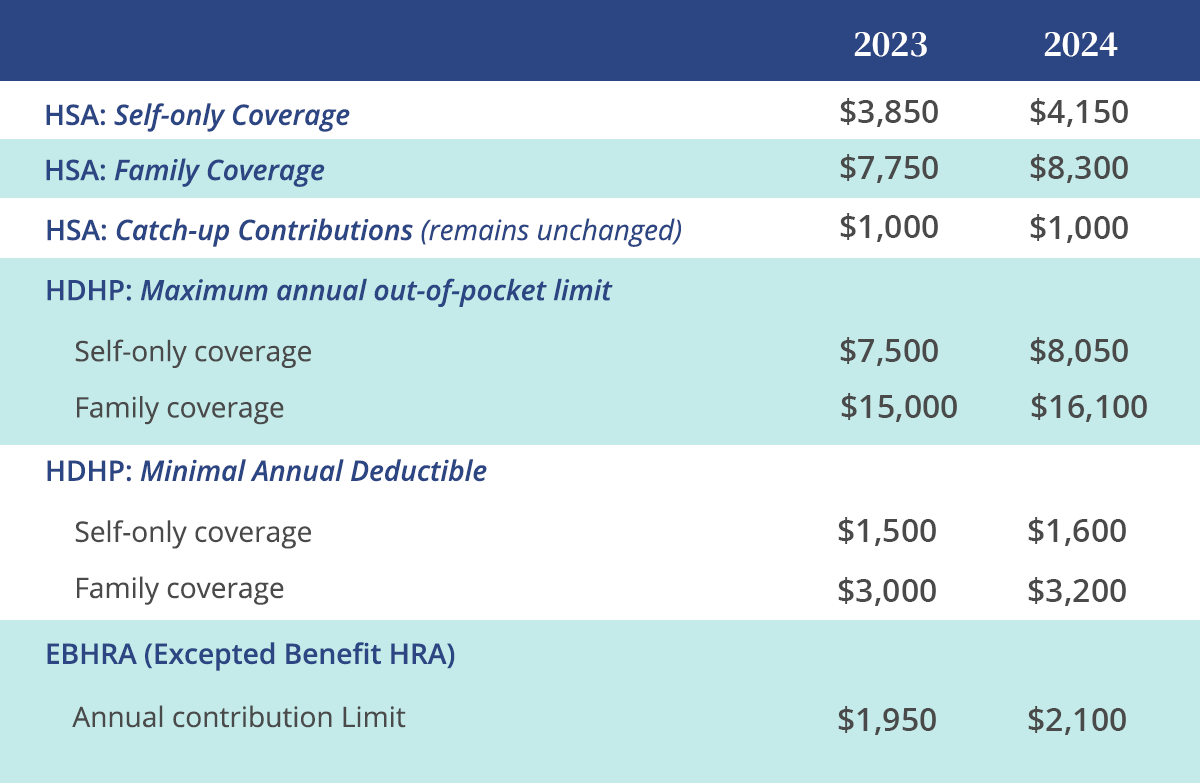
This week, the IRS released 2023 and 2024 limits for Health Savings Accounts (HSAs), Excepted Benefit Health Reimbursement Arrangements (EBHRAs), and High-Deductible Health Plans (HDHPs).

Below is a comparison of the 2023 and 2024 limits for HSAs and HDHPs.

Filed Under: Health Savings Accounts

  • 1
  • 2
  • 3
  • …
  • 16
  • Next Page »
Phone Us: 303-377-1399

Search GoGetCovered.com

Our Insurance Providers:

Join us on social media


Recent Updates

  • ONE BIG BEAUTIFUL BILL ACT – Here’s what you need to know
  • 2025 Contribution Limits – Updates
  • IRS Contribution Limits (What’s changing in January 2025)
  • IRS Contribution Limits (2024 Update)
  • IRS Releases 2024 Limits for HSAs, EBHRAs & HDHPs
  • 2022 Year-End Compliance Review
  • IRS Regulations Fix the ACA’s Family Glitch as of 2023
  • Health Plan Prescription Drug Reporting Mandate (RxDC)
  • IRS Releases 2023 Limits for Flexible Spending Accounts (FSA), Health Savings Accounts (HSA) and Commuter Benefits
  • Inflation Reduction Act to be Signed into Law, Includes Multiple Medicare Drug Pricing Reforms

site map · privacy policy · Copyright © 2026 · Cheryl Golenda Insurance Agency Inc. · theme by StudioPress · customized by Intent Design Studio · hosted by BlueHost · Log in

This website uses cookies to improve your experience. We'll assume you're ok with this, but you can opt-out if you wish. Cookie settingsACCEPT
Privacy & Cookies Policy

Privacy Overview

This website uses cookies to improve your experience while you navigate through the website. Out of these cookies, the cookies that are categorized as necessary are stored on your browser as they are as essential for the working of basic functionalities of the website. We also use third-party cookies that help us analyze and understand how you use this website. These cookies will be stored in your browser only with your consent. You also have the option to opt-out of these cookies. But opting out of some of these cookies may have an effect on your browsing experience.
Necessary
Always Enabled
Necessary cookies are absolutely essential for the website to function properly. This category only includes cookies that ensures basic functionalities and security features of the website. These cookies do not store any personal information.
SAVE & ACCEPT