
• Home
  • What We Do
  • About
  • Employee Benefits
  • Individual Info
  • Health Care Reform
  • Kudos
  • Blog
  • Contact

GoGetCovered.com

We help make getting covered easier! - Insurance for Businesses and Individuals

GoGetCovered: Insurance for Businesses and Individuals
  • Group Health
    • Large Group Health Insurance
    • Small Group Health Insurance
  • Group Life
  • Group Dental
  • Vision
  • Short Term
  • Disability
  • Individual/Family
  • Children
  • Travel

Adjusted 2018 HSA Limits Announced

April 3, 2018

UPDATED MARCH 5, 2018. The IRS released Internal Revenue Bulletin 2018-10 indicating changes to the 2018 HSA Family contribution maximum. The family contribution maximum is being adjusted downward to $6,850 (from the previously announced limit of $6,900). This change may affect current and future contributions to HSAs. Please make any necessary adjustments to future contributions to accommodate the change. If you have already fully contributed for 2018, you may need to initiate an excess contribution removal. 

The IRS initially released the 2018 cost-of-living adjustments for Health Savings Accounts (HSAs) in May 2017. However, the passing of the Tax Reform Bill led to a recalculation of the limits. HSAs are subject to annual adjustments. HSA limits consist of the contribution limits, minimum deductible requirements and maximum out-of-pocket limits.

2018 HSA Contribution Limit

The HSA limits for contributions are set to increase in 2018. Individuals age 55 or older can continue to make an additional $1,000 catch-up contribution.

Individual: $3,450 (up from $3,400 in 2017)

Family: $6,850 (up from $6,750 in 2017)

HSA HDHP Requirements

The minimum deductible requirements are set to increase in 2018. For employers and individuals that are currently in a plan set at or near the minimum deductible limits, you will need to make adjustments to ensure your plan continues to remain HSA eligible.

Individual:
$1,350 minimum deductible (up from $1,300)
$6,650 maximum out-of-pocket (up from $6,550)

Family:
$2,700 minimum deductible (up from $2,600)
$13,300 maximum out-of-pocket (up from $13,100)

For individuals following the American Health Care Act, a bill has passed the House of Representatives and is up for consideration in the Senate.  If the American Health Care Act became law, it would further expand these limits and make HSAs more flexible.
Filed Under: Health Savings Accounts, Taxes

Amendment 69 – Not Good for Colorado

August 3, 2016

When Coloradans go to the polls this November, they’ll face a decision on an issue that could have a greater effect on their everyday lives than anything else on the ballot. No, not the presidential election, but Amendment 69, or ColoradoCare a government-run, single-payer health care system fueled by $25 billion in new taxes in the first year alone.

To put this massive amount into perspective, consider that the state’s entire spending is $27 billion, so this one program would essentially double the Colorado budget.

Amendment 69 means new income taxes for everyone

While there are many unanswered questions about how this immense new program would work, the proposed legislation is clear on who’ll pay for it:

Employers would pay a new 6.67 percent payroll tax.

Workers would pay another 3.33 percent payroll tax.

Many businesses would pay both sides of the tax, for a total of 10 percent.

This double whammy would apply to more than 235,000 Colorado companies structured as “pass-through” entities – sole proprietors, partnerships, S corporations, LLCs, LLPs, many trusts, and more.

On top of that, there’s a 10 percent tax on non-payroll sources of income, such as business interests, rentals, capital gains, even taxable retirement benefits like Social Security and pensions.

The $25 billion-per-year price tag tops the list of reasons to vote NO on Amendment 69, not to mention the new 10 percent tax burden on your clients, the affect it will have on the health insurance industry and the impact ColoradoCare will have on the overall Colorado economy.

It’s our responsibility to take action – visit Colorado For Coloradans for more information.

Filed Under: Taxes

2017 HSA Changes and Out of Pocket Maximum Updates

August 2, 2016

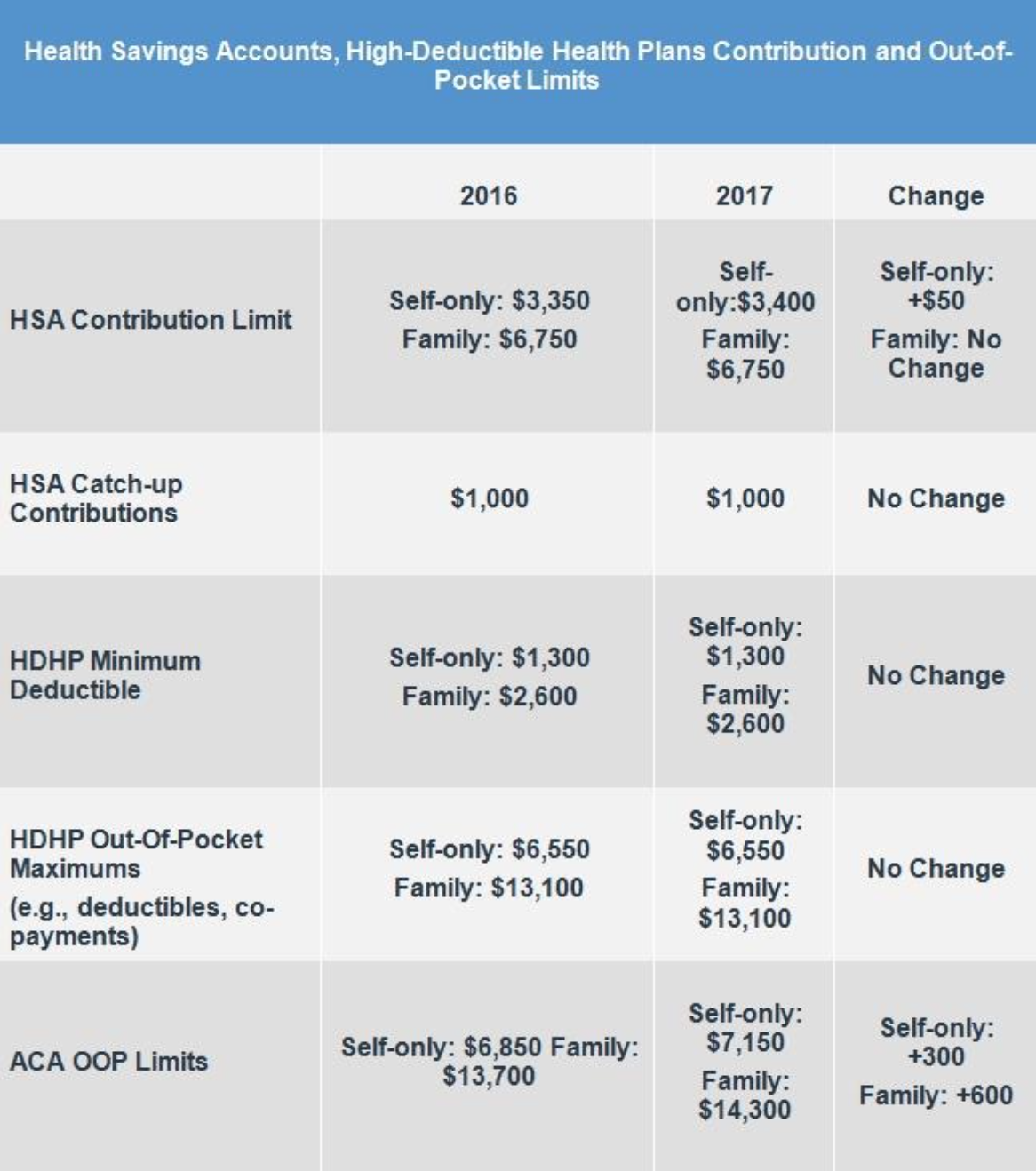
The Internal Revenue Service (IRS) recently released the inflationary adjustments for 2017 High-Deductible Health Plan (HDHP) and Health Savings Account (HSA) plans. Generally, the limits for 2016 and 2017 will remain the same, with the exception of the self-only HSA maximum contribution limit.

The Affordable Care Act (ACA) Out-Of-Pocket (OOP) and cost-sharing limits are other threshold amounts employers should be aware of; those limits are adjusted by the Department of Health and Human Services (HHS). These limits may differ slightly from each other (i.e., the ACA cost-sharing limit is higher than the OOP for HDHPs). In order for a plan to qualify as an HDHP, it must comply with the lower OOP maximum limit. (For 2017 that limit is $6,550 for self-only and $13,100 for family plans, but keep in mind that individual deductibles must be embedded, meaning each individual covered on a family HDHP can only be required to meet the self-only deductible).

Employers with an HDHP and an HSA should ensure their plans are compliant with the new limits by the first day of their plan year in 2017.

table comparing 2016 and 2017: Health Savings Accounts, High-Deductible Health Plans Contribution and Out-of-Pocket Limits

Filed Under: Affordable Care Act, Health Savings Accounts, Taxes

Proposed Summary of Benefits Changes

March 3, 2016

A Summary of Benefits and Coverage (SBC) is four-page (double-sided) communication required by the federal government. It must contain specific information, in a specific order and with a minimum size type, about a group health benefit’s coverage and limitations. In February 2016, the Department of Labor (DOL) issued proposed revisions to the template and related materials. The agency expects final templates and materials to apply to plan or policy years beginning on or after January 1, 2017. The proposal includes both a blank template and a sample completed template along with instructions for completion. The agency has also invited public comments on the proposed template, to be submitted on or before March 28, 2016. All information about current and proposed SBCs, including a proposed uniform glossary and more can be found on the DOL’s website.

For fully insured plans, the insurer is responsible for providing the SBC to the plan administrator (usually this is the employer). The plan administrator and the insurer are both responsible for providing the SBC to participants, although only one of them actually has to do this.

For self-funded plans, the plan administrator is responsible for providing the SBC to participants. Assistance may be available from the plan administrator’s TPA, advisor, etc., but the plan administrator is ultimately responsible. (The plan administrator is generally the employer, not the claims administrator.)

Proposed Changes

The proposed template is shorter than the original four-page (double sided) communication. It includes a new “important question” that asks “Are there services covered before you meet your deductible?” and requires family plans to disclose whether or not the plan has embedded deductibles or out-of-pocket limits. This is reported in the “why this matters” column in relation to the question “what is the overall deductible?” and plans must list “If you have other family members on the policy, they have to meet their own individual deductible until the overall family deductible has been met” or alternatively, “If you have other family members on the policy, the overall family deductible must be met before the plan begins to pay.”

Tiered networks must be disclosed and the question “Will you pay less if you use a network provider” is now included. The proposed SBC also includes language that warns participants that they could receive out-of-network providers while they are in an in-network facility. The SBC also indicates a consumer could receive a “balance bill” from an out-of-network provider.

The “explanatory coverage page” was dropped from the proposed template.

The provided coverage examples provide clarification to the “having a baby” example and the “managing type 2 diabetes” example, in addition to providing a third example of “dealing with a simple fracture.” The coverage example must be calculated assuming that a participant does not earn wellness credits or participate in an employer’s wellness program. If the employer has a wellness program that could reduce the employee’s costs, they must include the following language: “These numbers assume the patient does not participate in the plan’s wellness program. If you participate in the plan’s wellness program, you may be able to reduce your costs.
The column for “Limitations, Exceptions, & Other Important Information” must contain core limitations, which include:

• When a service category or a substantial portion of a service category is excluded from coverage (i.e., column should indicate “brand name drugs excluded” in health benefit plans that only cover generic drugs);

• When cost sharing for covered in-network services does not count toward the out-of-pocket limit;

• Limits on the number of visits or on specific dollar amounts payable under the health benefit plan; and

• When prior authorization is required for services.

The proposed template and instructions indicate that qualified health plans (those certified and sold on the Marketplace) that cover excepted abortions (such as those in cases of rape or incest, or when a mother’s life is at stake) and plans that cover non-excepted abortion services must list “abortion” in the covered services box. Plans that exclude abortion must list it in the “excluded services” box, and plans that cover only excepted abortions must list in the “excluded services” box as “abortion (except in cases of rape, incest, or when the life of the mother is endangered).” Health plans that are not qualified health plans are not required to disclose abortion coverage, but they may do so if they wish.

Filed Under: Federal Regulations

Talk about Skinny Plans

March 3, 2016

Proposed regulations would close a loophole that allowed certain employers to skirt the Affordable Care Act’s minimum value requirement.

Background

The Affordable Care Act applies to employers with 50 or more full-time equivalent employees. It requires them to offer their full-time employees coverage that:

Is affordable. The employees share of the annual premium for the lowest priced self-only plan can be no greater than 9.5 percent of annual household income.  Some employers have tried to avoid the Affordable Care Act’s (ACA) employer mandate by reducing full- time employees’ hours. But doing so can earn you a visit with a judge. The ACA requires employers with more than 50 full-time equivalent employees to provide affordable health insurance that meets certain minimum coverage requirements. Employers must provide this coverage to all full-time or full-time equivalent employees, which the law defines as working an average of 30 or more hours per week. What’s wrong with reducing employees’ hours to avoid covering them? Section 510 of ERISA, the Employee Retirement Income Security Act of 1974, makes it unlawful to “discriminate against a participants.

Meets minimum value standards. The law defines a minimum value plan as one designed to pay at least 60 percent of the total cost of medical services for a standard population.

Covers certain “essential health benefits,” or ten broad areas of treatments and services. The Affordable Care Act requires all health plans offered in the individual and small group markets, both inside and outside of the health insurance exchanges, to cover essential health benefits. It also prohibits plans from placing annual dollar limits on these essential health benefits for plan years starting January 1, 2014.

The essential health benefits provision— arguably the most costly portion of the law— does not apply to large group health plans. This creates a loophole for large employers, generally those with 101 or more employees. Although large group plans must cover preventive care services with no copayment, they do not have to cover “essential health benefits.”

Skinny Health Plans

Skinny plans designed to meet ACA requirements for large employers cover the ACA-required preventive services. To keep premiums low, however, they do not cover the “essential health benefits,” or place a very low limit on those benefits, such as $100 per hospitalization. This allows insurers to develop skinny plans that cost only a fraction of what an ACA-compliant plan would cost.

Although skinny plans meet the ACA’s affordability standard—because they don’t cover much—they do not meet the minimum value standard. A health plan meets this standard if it’s designed to pay at least 60 percent of the total cost of medical services for a standard population.

The ACA makes a premium tax credit available to individuals who do not receive qualifying employer health coverage, if their household income is between 100 percent and 400 percent of the federal poverty level. This allows them to buy coverage on the individual market. People who receive an offer of ACA-qualifying coverage from their employer cannot get the tax credit. If the ACA applies to your organization and any of your employees or their family members enroll in an individual market health plan through an exchange and receive a tax credit, you will be subject to a fine.

In early November 2014, the IRS warned that “certain group health plan benefit designs that do not provide coverage for in- patient hospitalization services are being promoted to employers.” In a notice issued by the IRS, the agency said that it believed that such plans “…do not provide the minimum value intended by the minimum value requirement.” The IRS said that it and the Department of Health and Human Services (HHS) would propose regulations to close this loophole, with the goal of finalizing and implementing them in 2015.

For a review of your organization’s health plan or to discuss your coverage options for renewals, please contact our office.

Filed Under: Affordable Care Act

  • « Previous Page
  • 1
  • …
  • 12
  • 13
  • 14
  • 15
  • 16
  • Next Page »
Phone Us: 303-377-1399

Search GoGetCovered.com

Our Insurance Providers:

Join us on social media


Recent Updates

  • ONE BIG BEAUTIFUL BILL ACT – Here’s what you need to know
  • 2025 Contribution Limits – Updates
  • IRS Contribution Limits (What’s changing in January 2025)
  • IRS Contribution Limits (2024 Update)
  • IRS Releases 2024 Limits for HSAs, EBHRAs & HDHPs
  • 2022 Year-End Compliance Review
  • IRS Regulations Fix the ACA’s Family Glitch as of 2023
  • Health Plan Prescription Drug Reporting Mandate (RxDC)
  • IRS Releases 2023 Limits for Flexible Spending Accounts (FSA), Health Savings Accounts (HSA) and Commuter Benefits
  • Inflation Reduction Act to be Signed into Law, Includes Multiple Medicare Drug Pricing Reforms

site map · privacy policy · Copyright © 2026 · Cheryl Golenda Insurance Agency Inc. · theme by StudioPress · customized by Intent Design Studio · hosted by BlueHost · Log in

This website uses cookies to improve your experience. We'll assume you're ok with this, but you can opt-out if you wish. Cookie settingsACCEPT
Privacy & Cookies Policy

Privacy Overview

This website uses cookies to improve your experience while you navigate through the website. Out of these cookies, the cookies that are categorized as necessary are stored on your browser as they are as essential for the working of basic functionalities of the website. We also use third-party cookies that help us analyze and understand how you use this website. These cookies will be stored in your browser only with your consent. You also have the option to opt-out of these cookies. But opting out of some of these cookies may have an effect on your browsing experience.
Necessary
Always Enabled
Necessary cookies are absolutely essential for the website to function properly. This category only includes cookies that ensures basic functionalities and security features of the website. These cookies do not store any personal information.
SAVE & ACCEPT