
• Home
  • What We Do
  • About
  • Employee Benefits
  • Individual Info
  • Health Care Reform
  • Kudos
  • Blog
  • Contact

GoGetCovered.com

We help make getting covered easier! - Insurance for Businesses and Individuals

GoGetCovered: Insurance for Businesses and Individuals
  • Group Health
    • Large Group Health Insurance
    • Small Group Health Insurance
  • Group Life
  • Group Dental
  • Vision
  • Short Term
  • Disability
  • Individual/Family
  • Children
  • Travel

Updates -Three ACA Taxes Repealed and 5th Circuit Decision in Two Major Events This Week

July 13, 2020

The week of Dec. 16, both chambers of Congress passed two year-end spending agreements to fund the federal government until Sept. 30, 2020 (H.R. 1158 and H.R. 1865). President Trump is expected to sign them into law before the Dec. 20 funding deadline. One of the agreements, H.R. 1865, the Further Consolidated Appropriations Act of 2020, included a full repeal of three taxes originally imposed by the Affordable Care Act (ACA): the 40% Excise Tax on employer-sponsored coverage (a.k.a. “Cadillac Tax”), the Health Insurance Industry Fee (a.k.a. the Health Insurer Tax), and the Medical Device Tax. Separately, on Dec. 18, the United States Court of Appeals for the Fifth Circuit ruled the ACA’s individual mandate is unconstitutional, but it did not invalidate the rest of the law. As a result, the rest of the law remains in effect. See below for more details.

Cadillac Tax

The Cadillac Tax would have imposed a 40% excise tax on coverage in excess of certain thresholds. When originally enacted in the ACA, the thresholds were $10,200 for self-only and $27,500 for family coverage with a 2018 effective date. The Cadillac Tax was delayed multiple times since passage of the ACA, and is now fully repealed, meaning it no longer exists and will never take effect.

Many employers, unions, insurers and industry groups have opposed the tax based on concerns around administrative and financial burdens for employers and adverse outcomes for employees.

Health Insurer Tax

H.R. 1865 also fully repeals the Health Insurer Tax, beginning in 2021. The $8 billion fee was implemented in 2014 and continued to increase each year. The fee only applied to insured business, including insured Medicare plans, based on each insurer’s share of the taxable health insurance premium base.

Due to the adverse impact on health insurance premiums, the fee was suspended in 2017 and 2019. It is important to note that the fee will be in effect for 2020 as no suspension was granted for that year; then, it will be repealed effective 2021.

Medical Device Tax

The Medical Device Tax imposed a 2.3% excise tax on U.S. medical device revenues. The tax was in effect over 2013-2015, and was suspended from 2016-2019. H.R. 1865 fully repeals the tax, effective Dec. 31, 2019.

Other notable items passed in the spending agreements include: legislation requiring the Administration to maintain certain policies (e.g., “silver loading”) for the individual Exchange markets to ensure consumers do not experience any disruptions for plan year 2021; legislation to prevent brand drug manufacturers from blocking access to samples of their products for generic drug development (a.k.a. the Creating and Restoring Equal Access to Equivalent Samples [CREATES] Act); and legislation to fund several expiring health programs until May 22, 2020. Read the final two-year spending package [PDF] for more details about these and other spending agreements.

Federal Appeals Court Ruling in Texas v. United States

A panel of the United States Court of Appeals for the Fifth Circuit ruled the ACA’s individual mandate is unconstitutional Wednesday. The court upheld the district court’s determination that the individual mandate is unconstitutional because it is no longer a tax with the zeroed-out penalty. In the district court ruling, Judge O’Connor further stated that because the mandate was essential to the law, it could not be severed (or separated) from the rest of the ACA, which meant the entire ACA was invalid. The appellate court did not resolve the severability issue or determine if any other provisions of the ACA should also be struck down. Instead, the panel remanded the case back to Judge O’Connor for further analysis of which other provisions of the ACA, if any, should be invalidated along with the individual mandate.

As a result of this new ruling, all remaining provisions of the law remain in effect – except for the newly repealed taxes listed above with their separate effective dates – while the legal process continues.

California Attorney General Xavier Becerra, who leads the 20 Democratic states that defended the ACA in this case, announced that the California Department of Justice is prepared to ask the U.S. Supreme Court to review the Fifth Circuit’s ruling. This is expected to be a long process and we will continue to keep you updated until there is a final resolution.
Filed Under: Affordable Care Act

2019 ACA and HSA Inflation Adjustment

December 28, 2018

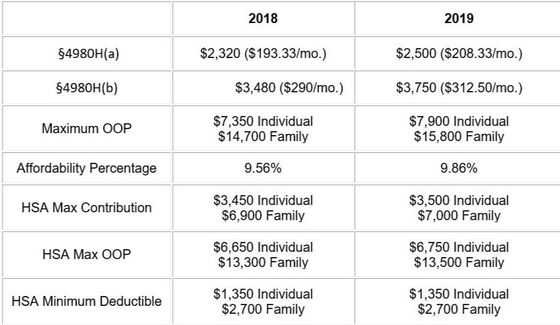
Earlier this year the IRS announced its 2019 inflation adjustment indexing for a number of ACA  provisions such as the employer shared-responsibility penalty affordability percentage (employee contribution limit that determines employer penalty), and Maximum out of pocket limits.

The two shared-responsibility penalties are for when employers fail to meet the minimum essential coverage (4980H(a)) and minimum value and affordability (4980H(b)). The section 4980H(a) penalty may be assessed when an ALE (applicable large employer) does not offer minimum essential coverage to at least 95 percent of its full-time employees, and at least one full-time employee receives a premium tax credit. The section 4980H(b) penalty may be assessed if an ALE offers minimum essential coverage to at least 95 percent of its full-time employees, but at least one full-time employee receives a premium tax credit because the coverage offered was not considered affordable and/or did not provide minimum value.

Employers need to make sure that they don’t overlook the adjusted ACA cost-sharing limits as they could face sharp penalties under the ACA’s shared responsibility provisions. In addition to the ACA adjusted index, the IRS released the 2019 HSA inflation-adjusted contribution limits as well:

2019 ACA and HSA Inflation Adjustment chart

Filed Under: Affordable Care Act, Health Savings Accounts

ACA Ruled Unconstitutional – Law Remains in Effect During Appeal

December 18, 2018

On Dec. 14, 2018, U.S. District Judge Reed O’Connor issued a ruling that determined the Affordable Care Act (ACA) is unconstitutional because of last year’s change to the federal tax law that zeroed out the ACA’s individual mandate penalty. The ruling was in favor of Texas and a number of states in Texas v. United States, which is the most recent in a series of judicial challenges to the ACA. The ruling is expected to be appealed, and the ACA remains in effect.

How did we get here? 
The U.S. Supreme Court has upheld the ACA as constitutional twice since the law was enacted. In the 2012 decision, the Supreme Court ruled that the individual mandate was a tax, which Congress has authority to impose, and therefore the ACA was constitutional.

The plaintiffs in the Texas v. United States litigation argued that when the mandate penalty was reduced to zero in the 2017 Tax Cuts and Jobs Act, the tax was effectively eliminated, so the individual mandate – and ACA as a whole – is unconstitutional. Judge O’Connor agreed that the mandate “can no longer be fairly read as an exercise of Congress’ tax power.” He further stated that because the mandate was essential to the law, it could not be severed (or separated) from the ACA, which means the entire ACA is invalid.

What the ruling means for the ACA today
The Texas v. United States ruling is not an injunction and does not block the operation of the law, so the ACA remains in effect. California is expected to appeal Judge O’Connor’s ruling. The newly elected Democratic majority in the U.S. House is also expected to support the appeal. This is the first step in what is expected to be a long legal process.

On Dec. 15, the Centers for Medicare & Medicaid Services (CMS) stressed that open enrollment for health coverage on the public Marketplaces would continue as planned, and there would be no impact to coverage or subsidies for 2019. While open enrollment ended in most states on Dec. 15, some state-run Marketplaces* have extended open enrollment periods. Individuals interested in purchasing coverage should confirm enrollment deadlines with their state-specific Marketplace.

Potential impact moving forward
If the ruling is upheld on appeals, the entire ACA – containing hundreds of provisions affecting all areas of the health care system – would be struck down. It would void ACA provisions such as protections for people with preexisting conditions, 100% coverage for certain preventive services, dependents remaining on their parents’ health plan until age 26, and more. It could also mean Americans who buy plans on the public Marketplace would be at risk of losing their health coverage, as well as those who receive coverage as a result of Medicaid expansion that has been adopted in 36 states plus the District of Columbia.

Filed Under: Affordable Care Act, Announcements

Good Advice for Shopping for Health Insurance if your a Self Employed -1099 Worker

December 12, 2018

There has been ample conversation this week about why enrollments in ACA-compliant coverage obtained through healthcare.gov are down more than 10 percent from the same time period during last year’s open enrollment period (OEP). Top reasons given are the removal of tax penalties for the Individual Mandate, increased availability of such low-cost alternatives as short-term health plans, and steep declines in the government’s marketing budget pertaining to ACA coverage.

All of these variables are likely to prove impactful once we are through the 2019 Open Enrollment Period (OEP19) and have a chance to take a closer look at them. But while we’re in the final stretch and finding coverage for everyone who’s eligible is critical, we want to focus on a group that may be at greater risk of getting the wrong coverage or missing out altogether — 1099 workers, AKA the “gig economy.”

Why would these workers be at greater risk? Often, 1099 (which refers to the tax form they receive for contract-based employment) workers have multiple jobs but none qualify them for company-sponsored health coverage. So, they’re on their own to navigate a process that’s very complex and potentially costly if you don’t know where and how to look.

Here are seven things that freelancers and gig workers should ensure as they get out there and get covered before it’s too late!

You MUST enroll by December 15 in most states. ACA coverage, like most employer-based coverage, requires you to enroll during an annual open enrollment period (OEP). After that, only a change in life status, like having a baby, qualifies you to pick up coverage before 2020. You may have heard that you can enroll in a short-term health plan anytime throughout the year. That’s true but if you want to enroll because you’ve become sick or had an accident, don’t expect to get it because short-term plans can deny coverage based on pre-existing conditions.

Most people qualify for subsidies. According to healthcare.gov, nearly 90% of customers shopping for individual health coverage qualify for a subsidy to help pay their monthly premium, and nearly that many also qualify for cost-sharing reductions (CSRs) that help reduce their out-of-pocket costs when they have to use their insurance throughout the year. The ACA provides subsidies for people who make up to 400% of the FPL annually. That equates to $48,560 for an individual, $100,400 for a family of 4, and $169,520 for a family of 8. Gig workers tend to have income that would qualify them. If you are young and single and killing it with your income, then congratulations but it will unfortunately impact what you pay for insurance.

Use reliable websites and navigators. In Colorado the marketplace website is www.ConnectforHealthCo.com. About two-thirds of states use healthcare.gov and the rest have a “state-based exchange”. To see your options in your state, check out this list on healthcare.gov. and always be sure you’re going with a reputable source. Robocall scammers are a serious problem and you should never enroll based on a recorded message you received.

Beware of plans that aren’t ACA-compliant and those who try to get you to buy them.The Trump Administration expanded the availability of short-term plans to individuals this year. Some brokers are offering them exclusively or selling them first because they can be less expensive than the pre-subsidy rate for ACA-compliant plans—and because brokers get paid more to sell them. But they are NOT comprehensive health coverage — they’re more like cut-rate, collision-only auto insurance that only helps you if you get hit by a bus. ACA-compliant plans offer mental health coverage, maternity care, prescription drug coverage, annual physicals, and free flu shots, among other things and all mandated. Short-term plans offer none of those things. Make sure you know what you’re buying and look for disclaimers, or just ask the broker you’re using, about whether a plan is ACA-compliant.

Know your income. Technically, your subsidy is an “advanced premium tax credit” (APTC), meaning your annual taxes are being diverted to pay a portion (or all) of your health insurance premium. Contract workers may not have consistent income, which can make it tougher to estimate what you may make in the coming year. But you are likely more familiar with how to claim deductions and expenses that can reduce their income and increase the subsidy amount(s) for which you qualify. Be honest about your income but also don’t be too conservative about your income so you don’t miss out on lowering your healthcare costs.

Compare cost and coverage levels. Individual coverage is organized into metal-level tiers that let you know what you’re getting for your money: Platinum (best), gold, silver, and bronze. For most people’s personal health circumstances, silver is more than adequate coverage, which is why it’s selected by about three-quarters of individual market customers. But read the “plan details” before making your final selections to ensure you’re getting what you need for your personal needs. If plan details aren’t available where you’re shopping, find somewhere else to shop!

Look beyond premium costs alone. There are many variables to consider when looking at your insurance, so don’t just find the lowest-cost plan and call it a day. You will also want to look at deductible, which is what you pay out of your own pocket before your insurance kicks in for a lot of services; the copay, which is how much you pay vs. how much your insurance pays for things like doctor visits and prescription drugs, and coinsurance, which is how much you may pay vs. your insurance even after meeting your deductible.

Health insurance is a critical part of both your physical and financial well-being. Don’t miss your opportunity to protect yourself and your family in 2019 and beyond!

Filed Under: Affordable Care Act, Healthcare Regulations, Self-Employed, Taxes

Helpful Links for You

December 11, 2018

Connect for Health Colorado – Colorado’s Affordable Care Act (ACA) Qualified Health Insurance Marketplace

Colorado Division of Insurance – The Colorado Division of Insurance (DOI) regulates the insurance industry in Colorado, and assists consumers by answering their questions, investigating their complaints, and helping them to understand their insurance.

Healthcare.gov – National Health Insurance Marketplace and a great resource for ACA information

ACA Tax Calculator – Estimate your potential ACA penalty

Medicare.gov – The official U.S. government site for Medicare

Healthcare Bluebook – Never overpay for healthcare again

Good Rx – Stop paying too much for your prescriptions

HSA Center – A great resource for Health Savings Account information

9Health Fair – As the largest volunteer-driven, non-profit health and education program in the nation, 9Health Fair is committed to providing life-saving early detection and prevention to help you and your family stay healthy.

LiveHealth Online – See a Doctor 24/7 on your computer or mobile device

Dispatch Health – On-demand Urgent Care in the comfort of your home or work

Filed Under: Affordable Care Act, Colorado health and insurance resources

  • « Previous Page
  • 1
  • 2
  • 3
  • 4
  • 5
  • Next Page »
Email Icon Email Us: Cher@gogetcovered.com

Search GoGetCovered.com

Our Insurance Providers:

Join us on social media


Recent Updates

  • ONE BIG BEAUTIFUL BILL ACT – Here’s what you need to know
  • 2025 Contribution Limits – Updates
  • IRS Contribution Limits (What’s changing in January 2025)
  • IRS Contribution Limits (2024 Update)
  • IRS Releases 2024 Limits for HSAs, EBHRAs & HDHPs
  • 2022 Year-End Compliance Review
  • IRS Regulations Fix the ACA’s Family Glitch as of 2023
  • Health Plan Prescription Drug Reporting Mandate (RxDC)
  • IRS Releases 2023 Limits for Flexible Spending Accounts (FSA), Health Savings Accounts (HSA) and Commuter Benefits
  • Inflation Reduction Act to be Signed into Law, Includes Multiple Medicare Drug Pricing Reforms

site map · privacy policy · Copyright © 2026 · Cheryl Golenda Insurance Agency Inc. · theme by StudioPress · customized by Intent Design Studio · hosted by BlueHost · Log in

This website uses cookies to improve your experience. We'll assume you're ok with this, but you can opt-out if you wish. Cookie settingsACCEPT
Privacy & Cookies Policy

Privacy Overview

This website uses cookies to improve your experience while you navigate through the website. Out of these cookies, the cookies that are categorized as necessary are stored on your browser as they are as essential for the working of basic functionalities of the website. We also use third-party cookies that help us analyze and understand how you use this website. These cookies will be stored in your browser only with your consent. You also have the option to opt-out of these cookies. But opting out of some of these cookies may have an effect on your browsing experience.
Necessary
Always Enabled
Necessary cookies are absolutely essential for the website to function properly. This category only includes cookies that ensures basic functionalities and security features of the website. These cookies do not store any personal information.
SAVE & ACCEPT