
• Home
  • What We Do
  • About
  • Employee Benefits
  • Individual Info
  • Health Care Reform
  • Kudos
  • Blog
  • Contact

GoGetCovered.com

We help make getting covered easier! - Insurance for Businesses and Individuals

GoGetCovered: Insurance for Businesses and Individuals
  • Group Health
    • Large Group Health Insurance
    • Small Group Health Insurance
  • Group Life
  • Group Dental
  • Vision
  • Short Term
  • Disability
  • Individual/Family
  • Children
  • Travel

Wellness Programs and Incentives

February 10, 2022

Federal regulations are complex – understand the rules for “participatory” and “health-contingent” wellness programs and related incentives

Many employers offer wellness programs to support employees and their family members in improving their health. In addition to encouraging a culture of health, these programs are designed to reduce health care costs for both employees and the company.

The current trend in wellness programs is toward health-contingent programs that reward employees for outcomes such as smoking cessation, weight loss, and managing chronic conditions like diabetes and high blood pressure and cholesterol.

A consistent set of wellness program and incentive limit rules were adopted under the Affordable Care Act (ACA) by the Department of Labor (DOL), Health and Human Services (HHS), and the Internal Revenue Service (IRS) and made effective January 1, 2014. The regulations focus on:

  • Two types of wellness programs: participatory and health-contingent (activity-only or outcome-based)
  • Requiring reasonable alternatives in health-contingent programs so everyone has the opportunity to earn the full reward
  • Establishing the value of incentives that can be awarded for some types of programs
  • Requiring employers to offer the opportunity to earn incentives at least once per year

Other wellness program rules and regulations

The ACA rules are just one set of federal regulations that impact employer wellness programs. Rules adopted in 2016 by the fourth agency, the Equal Employment Opportunity Commission (EEOC), under the Americans with Disabilities Act (ADA) and Genetic Information Nondiscrimination Act (GINA) also need to be considered by employers when designing wellness programs.

The incentive limits in EEOC’s 2016 rules were challenged by the American Association of Retired Persons (AARP) as being too high and potentially coercive. The D.C. District Court found the limits to be insufficiently justified, and issued an order to vacate the rules on January 1, 2019 if clarification or new rules were not issued. The EEOC has formally removed incentive limits from ADA and GINA, but has not provided insight on an anticipated date for new rules. ADA and GINA incentive limits are no longer effective as of January 1, 2019. It is important to note that the remaining sections of the ADA and GINA rules (e.g., ADA’s reasonable accommodations and GINA’s limited use of collecting genetic information) remain in effect.

Americans with Disabilities Act (ADA)

Under the ADA regulations, employers are allowed to ask disability-related questions and conduct medical exams for voluntary wellness programs that promote health or wellness. There are several key differences between the ACA and the ADA:

  • Reasonable accommodations must be provided if an employee is unable to complete part or all of a wellness program for disability-related reasons (a reasonable alternative under the ACA can be considered a form of reasonable accommodation under the ADA)
  • Employers may only receive information from wellness programs in aggregate, any individually identifiable information received is considered PHI
  • Privacy notices describing the handling of medical information, and procedures for safeguarding information privacy must be distributed to all wellness program participants
ADA safe harbor not applicable

The statutory text of the ADA provides a safe harbor that allows medical inquiries and examinations to be conducted in connection with a “bona fide benefit plan.” This statutory language has been interpreted to include employer-sponsored wellness programs within that safe harbor, and the courts have agreed.* The final ADA regulations clearly state that the “bona fide benefit plan” safe harbor does not apply to rewards and penalties offered in connection with an employer’s wellness program that includes disability-related inquiries or medical examinations, and go on to state that the EEOC does not agree with the outcome of the cases on this issue.

Genetic Information Nondiscrimination Act (GINA)

Under GINA, employers may solicit genetic information from the employee as part of a wellness program, so long as it is made clear that disclosing this information is voluntary.

Other key differences between GINA and ACA include:

  • Limits use of genetic health information collected through a wellness program
  • Regulates sharing of health information collected from spouses
  • Prohibits health and genetic information collection from employees’ children
  • Prohibits the sale of genetic information provided through a wellness program to other vendors

In combination, it is clear that compliance with one set of regulations does not necessarily ensure compliance with all the others. Employers should review their wellness programs and incentives against all regulations, and consult with their current carrier and broker for more information.
Filed Under: Affordable Care Act, Federal Regulations, Wellness Incentives

Consolidated Appropriations Act Signed Into Law, Includes Multiple Health Care-Related Provisions

February 9, 2022

On Dec. 27, 2020, President Trump signed into law a $1.4 trillion government funding package (the Consolidated Appropriations Act, 2021) and a $900 billion COVID-19 relief bill providing critical pandemic aid and an extension of government funding through Sept. 2021. The Consolidated Appropriations Act, 2021 [PDF] includes a number of healthcare-related provisions. This update addresses two of those provisions: ending surprise billing for emergency and involuntary out-of-network services and requiring new health plan reporting on prescription drug spending.

No Surprises Act – Ending Surprise Medical Billing

For individual and group health plans, effective for plan years beginning on or after Jan. 1, 2022, the No Surprises Act ends surprise medical bills by holding the patient harmless for out-of-network (OON) care that meets certain criteria (emergency services or certain non-emergency situations where patients do not have the ability to choose an in-network provider) and air ambulance services. This means that patients will only be responsible for applicable in-network cost-sharing amounts for the OON services received.

The legislation requires health plans to make payments to OON providers after an applicable bill is submitted, but does not specify the amount of initial payment, nor any claims requirements.  If providers dispute the payment made, the plan and provider will enter into a 30-day open negotiation period to settle the claim. If the required negotiation proves unsuccessful, then either party may initiate a binding “baseball-style” arbitration process (called an Independent Dispute Resolution), with the arbitrator selecting one of the final best offers submitted by each party. The arbitrator can consider a wide range of relevant information when determining a final provider reimbursement amount but is prohibited from considering billed charges of the provider, including usual and customary charges or rates, or those paid by public programs such as Medicare, Medicaid, TRICARE, or any state benefit program.

Under limited circumstances, OON providers are still permitted to balance bill patients if they give patients notice of their network status, an estimate of charges 72 hours prior to providing services, and the patient gives consent.

Price and Provider Network Transparency

The No Surprises Act includes additional provisions intended to help patients understand their potential cost responsibilities for the care, as well as the network status of their providers. For plan years beginning on or after Jan. 1, 2022, individual and group health plans are required to:

  • Provide patients an Advanced Explanation of Benefits (EOB) for scheduled services or items at least three days prior to treatment.
    • The Advanced EOB must include (1) provider and/or facility network status, (2) the contracted rate based on billing/diagnostic codes submitted by the provider (for in-network providers only), and (3) good faith estimates of patient cost-sharing.
  • Offer a price comparison tool for consumers and make the information available by phone.
  • Maintain up-to-date online provider network directories.

Reporting Requirements on Pharmacy Benefits and Drug Costs

The Consolidated Appropriations Act, 2021 also creates a new reporting requirement for individual and group health plans. Beginning no later than one year after the law’s enactment, and by June 1 each year thereafter, health plans are required to report information on plan medical costs and prescription drug spending to the Secretaries of the Departments of Health & Human Services (HHS), Labor, and Treasury.

Information to be submitted includes:

  • The 50 brand prescription drugs most frequently dispensed by pharmacies for claims paid by the plan and the total number of paid claims for each such drug.
  • The 50 most costly prescription drugs with respect to the plan by total annual spending and the annual amount spent by the plan for each such drug.
  • The 50 prescription drugs with the greatest increase in plan expenditures over the plan year preceding the plan year that is the subject of the report and, for each such drug, the change in amounts expended by the plan or coverage in each such plan year.
  • Total spending on health care services includes: (1) hospital, health care provider, and clinical service costs, broken out for primary care and specialty care; (2) costs for prescription drugs; and (3) other medical costs, including wellness services.
  • Any impact on premiums by rebates, fees, or other compensation paid by drug manufacturers to the plan or its administrators or service providers, including the amounts paid for each therapeutic class of drugs, and the amounts paid for each of the 25 drugs that yielded the highest amount of rebates and other compensation during the plan year.
  • Any reduction in premiums and out-of-pocket costs associated with rebates, fees, or other compensation.
  • Average monthly premium paid by employers on behalf of enrollees, as applicable, and that paid by enrollees.

HHS is then required to publish a report of aggregate prescription drug pricing trends and the impact of such spending on premiums. The first report is expected to be published 18 months after the initial health plan reports are submitted. Subsequent reports will be published biannually.

Filed Under: COVID-19

Group Health Plans to Cover OTC COVID-19 Tests

February 9, 2022

This week, the Department of Labor, Health and Human Services, and the Treasury issued a new set of Frequently Asked Questions (FAQs) confirming that group health plans and issuers must provide 100% coverage of over-the-counter (OTC) COVID-19 diagnostic tests beginning January 15, 2022.

The FAQs are a further interpretation of the coverage mandate required by the Families First Coronavirus Response Act (FFCRA), as amended by the Coronavirus Aid, Relief, and Economic Security Act (CARES Act). Under this new guidance, 100% of the cost for COVID-19 tests purchased by an individual for diagnostic purposes on or after January 15, 2022, must be covered without cost-sharing or medical management requirements—even if the test was purchased OTC without a provider prescription or clinical assessment. This requirement continues for the duration of the national public health emergency.

The FAQs confirm that, per prior guidance that remains unchanged, the plan or issuer is generally not required to cover COVID-19 tests obtained for employment purposes or for other purposes that are not primarily intended for individualized diagnosis or treatment. Also, these new FAQs are separate from the U.S. government’s purchase of 500 million rapid tests and its commitment to mail tests free of charge to Americans who request them.

Per the FAQs, plans and issuers would be permitted to impose certain limitations that pertain to cost and quantity and that are intended to protect against fraud and abuse:

  • Where the plan or issuer provides direct coverage of OTC COVID-19 tests (i.e., pays the seller directly and does not require members to seek reimbursement post-purchase), coverage cannot be limited to only those tests provided through its program or by its preferred/in-network sellers. However, the plan or issuer may limit reimbursement of tests purchased outside its direct coverage program to the lower of $12 or the actual cost of the test.
  • With respect to OTC COVID-19 tests purchased during the public health emergency and without provider clinical assessment or involvement, the plan or issuer may limit the number of tests covered to no less than eight tests per covered individual per 30-day period (or calendar month).
  • The plan or issuer may take action to prevent, detect, and address fraud and abuse, provided that these do not create a significant barrier to obtaining tests. Examples include requiring proof of purchase or an attestation that a test was purchased for the member’s personal use (or their covered dependent’s use).

Plans or issuers who have questions about these FAQs should contact their agent or insurance company with any questions.

Filed Under: COVID-19

Out-of-pocket maximum for group health plans announced for 2023

February 9, 2022

OOPM released for the 2023 plan year represents a 4.3% increase from OOPM for the 2022 plan year.

  • Applies to: All states, Regulatory and compliance

The 2023 out-of-pocket maximum (OOPM) for health plans is $9,100 for single coverage and $18,200 for family coverage. The 2023 OOPM represents a 4.3% increase above the 2022 OOPM of $8,700 for self-only coverage and $17,400 for family coverage.

OOPM for 2023 plan year OOPM for 2022 plan year
Self-only: $9,100 Self-only: $8,700
Family: $18,200 Family: $17,400

The annual OOPM requirement applies to most non-grandfathered group health plans, regardless of whether the plan is fully insured or self-funded (ASO). It does not apply to grandfathered, transitional Relief, and retiree-only plans. The OOPM includes copayments, deductibles, and coinsurance amounts associated with both medical and pharmacy-covered benefits.

High-deductible plans with health savings accounts (HSAs) have limits that are different, including OOPM, deductible, and contribution limits. The Internal Revenue Service has not yet released final rules for 2023 HSA limits. Historically these are released in May. Please contact our office with any questions or concerns.

Filed Under: Health Savings Accounts, Out-of-pocket maximum

IRS Releases 2022 Limits for HSAs

May 18, 2021

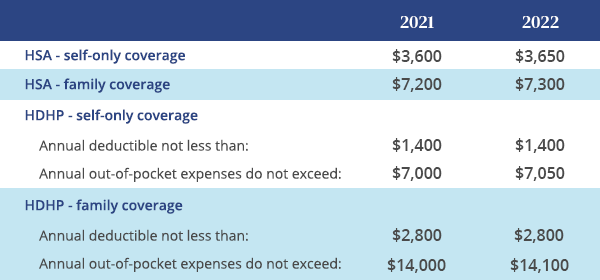
This week, the IRS released Revenue Procedure 2021-25, which includes the 2022 limits for health savings accounts (HSA) and high-deductible health plans (HDHP).
Below is a comparison of the 2021 and 2022 limits for HSAs and HDHPs.


Filed Under: Health Savings Accounts

  • « Previous Page
  • 1
  • …
  • 3
  • 4
  • 5
  • 6
  • 7
  • …
  • 16
  • Next Page »
Email Icon Email Us: Cher@gogetcovered.com

Search GoGetCovered.com

Our Insurance Providers:

Join us on social media


Recent Updates

  • Pharmacy forces shaping employer benefit strategies in 2026
  • ONE BIG BEAUTIFUL BILL ACT – Here’s what you need to know
  • 2025 Contribution Limits – Updates
  • IRS Contribution Limits (What’s changing in January 2025)
  • IRS Contribution Limits (2024 Update)
  • IRS Releases 2024 Limits for HSAs, EBHRAs & HDHPs
  • 2022 Year-End Compliance Review
  • IRS Regulations Fix the ACA’s Family Glitch as of 2023
  • Health Plan Prescription Drug Reporting Mandate (RxDC)
  • IRS Releases 2023 Limits for Flexible Spending Accounts (FSA), Health Savings Accounts (HSA) and Commuter Benefits

site map · privacy policy · Copyright © 2026 · Cheryl Golenda Insurance Agency Inc. · theme by StudioPress · customized by Intent Design Studio · hosted by BlueHost · Log in

This website uses cookies to improve your experience. We'll assume you're ok with this, but you can opt-out if you wish. Cookie settingsACCEPT
Privacy & Cookies Policy

Privacy Overview

This website uses cookies to improve your experience while you navigate through the website. Out of these cookies, the cookies that are categorized as necessary are stored on your browser as they are as essential for the working of basic functionalities of the website. We also use third-party cookies that help us analyze and understand how you use this website. These cookies will be stored in your browser only with your consent. You also have the option to opt-out of these cookies. But opting out of some of these cookies may have an effect on your browsing experience.
Necessary
Always Enabled
Necessary cookies are absolutely essential for the website to function properly. This category only includes cookies that ensures basic functionalities and security features of the website. These cookies do not store any personal information.
SAVE & ACCEPT