
• Home
  • What We Do
  • About
  • Employee Benefits
  • Individual Info
  • Health Care Reform
  • Kudos
  • Blog
  • Contact

GoGetCovered.com

We help make getting covered easier! - Insurance for Businesses and Individuals

GoGetCovered: Insurance for Businesses and Individuals
  • Group Health
    • Large Group Health Insurance
    • Small Group Health Insurance
  • Group Life
  • Group Dental
  • Vision
  • Short Term
  • Disability
  • Individual/Family
  • Children
  • Travel

The Dobbs Decision: How Dobbs v. Jackson Women’s Health Organization Affects Group Health Plans

July 26, 2022

Due to the Dobbs decision (Dobbs v. Jackson Women’s Health Organization), much has been written about whether an employer can cover the cost of travel for an employee working or residing in a state where abortion services are prohibited or seeking care in another state where abortion services are legal.

Section 213(d) of the Internal Revenue Code states that medical care includes amounts paid for transportation primarily for and essential to medical care related to the “diagnosis, cure, mitigation, treatment, or prevention of disease or for the prevention of disease or for the purpose of affecting any structure or function of the body.” The IRS, in Revenue Ruling 73-201.2 confirmed that because abortion services are deemed to be for the purpose of affecting a structure or function of the body, its cost is an amount paid for medical care as defined in the Code and was therefore deductible as a medical expense. Because the practice of medicine is regulated by the law of the state where the medical care is provided, and abortion services are clearly medical care, then if the care is received in a state where abortion is legal, expenses for travel for those services would be eligible for reimbursement as medical care under an employer’s group health plan.

Travel expenses incurred for the primary purpose of going to a state to receive abortion services can be offered on a tax-free basis under an employer’s group health plan, just like any other expense for medical care under the plan. There are limits that are imposed on the amount of the reimbursement for travel expenses, so to the extent that the plan will reimburse amounts beyond what is allowed, consideration needs to be given to how to treat those excess reimbursements as taxable income to the employee.

An employer can consider offering to pay for travel expenses on a pre-tax basis outside of its group health plan, but the employer should be aware that this specific benefit could be characterized as a standalone group health plan that must comply with the requirements of the Affordable Care Act, ERISA, HIPAA, and COBRA. Employers must take great care in establishing a benefit specifically for travel to seek out-of-state abortion services because it could make it easier for states where abortion is illegal to argue that by establishing a narrow travel expense reimbursement policy, the employer is facilitating access to abortion services in violation of state law.

If the employer wishes to consider establishing a travel and lodging benefit under their group health, the IRS has said that legally obtained abortion services are medical care and thus would be payable as medical expenses under an employer’s group health plan. Publication 502 states that a taxpayer can “include in medical expenses amounts paid for transportation primarily for, and essential to, medical care…[including] bus…train, or plane fares [and] transportation expenses of a parent who must go with a child who needs medical care.” Lodging expenses eligible for reimbursement are more limited. Publication 502 states that the taxpayer can only include “up to $50 for each night for each person. [The taxpayer] can include lodging for a person traveling with the person receiving medical care.”

Employers with self-funded plans will most likely work with their TPAs to determine if and how the plan will administer this benefit, including whether to cover travel for a broader range of covered medical services not available locally.

Employers offering fully-insured coverage will have to determine if such a benefit is available under those plans. If they aren’t, they may consider establishing an HRA or EBHRA that will reimburse eligible travel and lodging expenses incurred for a trip that is primarily for, and essential to, receiving medical services.

Self-insured employers can also establish an HRA or EBHRA for these purposes if they so choose. It is important to note that employers can determine the amount available under an HRA for reimbursement of expenses incurred for both abortion services and related travel and lodging. However, when establishing an EBHRA for reimbursement, there is an $1800 annual maximum limit which will apply.

Some employers have contemplated administering travel reimbursements outside of their health plan and treating such reimbursements as taxable income to the employee. There is some risk involved with this in that the employer needs to balance respecting the right of an employee to keep health care decisions private against requiring proper documentation of the expenses incurred and considering the scope of medical services for travel reimbursements.

Also, this type of policy would not be governed by ERISA, so an employer could not use the argument that ERISA preemption would apply to any state law attempts to restrict this benefit.

Insurance carriers and vendors will be rolling out new products and services to address travel. Some have already begun to offer “travel riders” for group health plans.

Before any of these options are considered, it is strongly recommended that the employer seek counsel from their tax or legal advisor
Filed Under: Transit Plans, Womens Health

Changes in Women’s Health Care Regarding Abortions

July 21, 2022

The Dobbs decision will have far-reaching implications for employees seeking abortion services and the health care professionals who provide them. Employers who may offer a broad range of reproductive health benefits through their employee benefit plans will also be asking many questions about continued coverage for and access to these abortion services.

Coverage for employees can be offered in one of two types of plan designs: fully-insured and self-insured coverage. With a fully-insured plan, the state-licensed insurer bears the risk of all claims incurred under the policy.

Employers who choose to self-fund their health benefits assume the risk of and pay claims incurred by their employees. These self-funded plans are administered under contracts with third-party administrators.

Employers offering fully-insured coverage

If a state should prohibit the delivery of abortion services within its borders, any insurance company licensed by the state to issue insurance policies to employers and individuals in that state will be unable to provide coverage for abortion services within that state. Many fully-insured plans operating in states where abortion services may no longer be legal may have in-network providers in other states and/or provide coverage for out-of-network services. These fully-insured carriers could possibly continue to pay claims for abortion services provided in states where abortion remains legal. To the extent state law precludes an insurance company within the state from issuing coverage for abortion services, the insurance company would have to comply with such restrictions, since insurance is generally regulated by state law.

For employers with fully-insured plans operating in states that prohibit insurance coverage for and access to abortion services, they will need to consider other options if they wish to continue providing assistance for these services. It is recommended that employers discuss options with their benefits consultants and legal counsel.

Employers offering self-insured coverage

Employers who offer self-funded health care benefits for abortion services should be able to continue to offer this coverage to their benefits-eligible employees regardless of whether any states may ban insurance coverage for abortion services. Because self-funded plans are governed by ERISA and ERISA has pre-emption provisions that override state law that relates to an employee benefit plan, coverage for abortion services could continue.

Even though self-funded employers may continue to offer coverage for abortion services under their group health plans, access to these services for employees working or residing in states where abortion services are prohibited will be restricted. Employers whose group health plans have in-network providers in multiple states can continue to provide coverage and access to abortion services from such providers in states where abortion services are legal.

If the employer’s self-funded group health plan has out-of-network coverage, employees could seek abortion services from an out-of-network provider. Some group health plans cover out-of-network care when there is no in-network provider in a service area at the in-network benefit level.

Here are some action steps an employer should consider:

  1. Communicate. Communicate with your broker/benefits consultant, third-party administrator, pharmacy benefit manager, and insurance company to understand what options may be available or to ensure that the current benefits will still be applicable depending on the state in which the employer is located.
  2. Consider the way in which your medical benefits are funded. If feasible, employers who offer fully-insured health plans, which are subject to state law limitations on abortion services, might consider a transition to self-insured coverage. This would warrant discussion with the broker/benefits consultant to make sure this is the right strategy.
  3. Review provider network access. If your group health plan has a limited provider network, i.e., an HMO or EPO, you may want to consider expanding in-network coverage or perhaps adding an out-of-network benefit that might give employees access to covered abortion services in states where such services remain available.
  4. Establish a Health Reimbursement Arrangement for abortion services. Taking great care to implement a health reimbursement arrangement (HRA) ensuring that it complies with the Affordable Care Act, ERISA, HIPAA, COBRA, and related regulatory guidance, employers, whether offering fully-insured or self-insured major medical coverage, can consider establishing an HRA that covers any unreimbursed expenses for medical care, as defined in Code section 213(d). The HRA would either need to be integrated with the employer’s medical plan or it would have to be structured as an Excepted Benefit HRA (EBHRA).
  5. Review. Review any group health plan documentation and other employee communications to ensure they align with whatever changes in benefits will result from the Dobbs decision.

Employers must be aware that ERISA requires that plan documentation reflect the benefits available to plan participants. Because benefits may change as a result of Dobbs, employers should ensure that they provide proper notice of any changes to reproductive health benefits under their group health plans.

Employee communications should be prepared to clearly explain in plain language how coverage for abortion services may change and if continued to be offered, how employees can continue to access them.

Employees may have a lot of questions about their access to abortion services. In addition to any company communications, the employer should be prepared to tell employees about the details of coverage and access to abortion services benefits. Please contact our office if you have further questions or concerns.

Filed Under: COBRA, Healthcare Regulations

IRS Releases 2023 Limits for HSAs

May 11, 2022

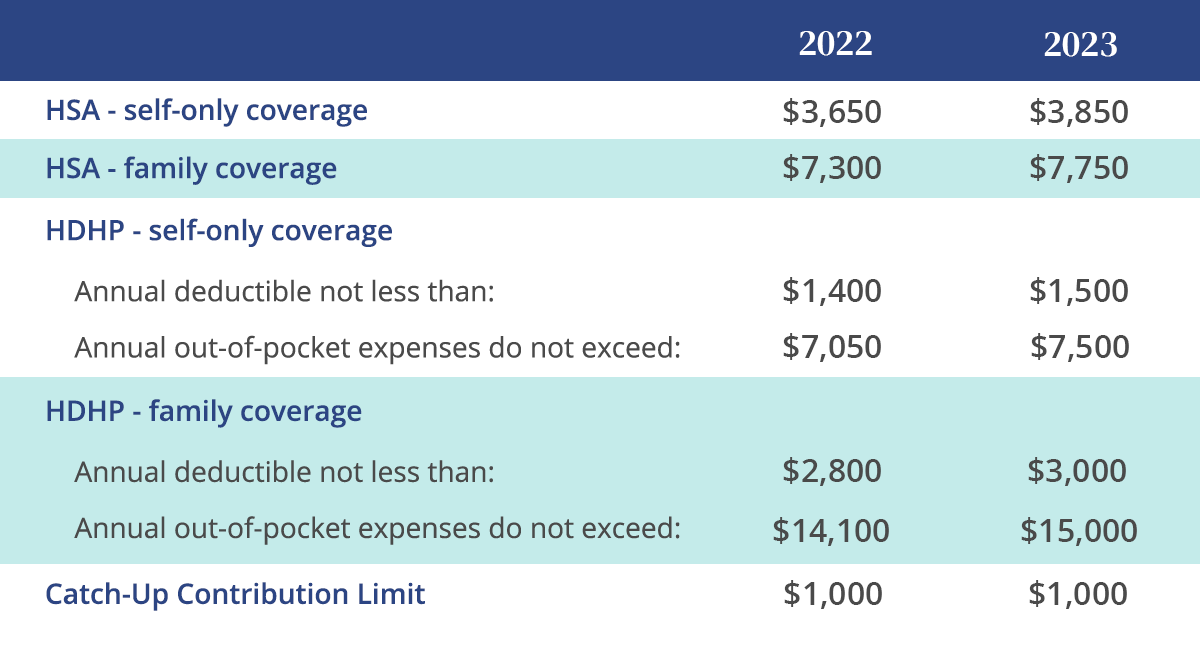
This week, the IRS released IRS Rev. Proc. 2022-24, which includes the 2023 limits for health savings accounts (HSA) and high-deductible health plans (HDHP).
Below is a comparison of the 2022 and 2023 limits for HSAs and HDHPs.
If you have any questions, get in touch with our team for more information.

Filed Under: Health Savings Accounts

Proposed Rule to Fix “Family Glitch” Introduced to Strengthen the Affordable Care Act

April 11, 2022

On April 6, the Biden Administration released a proposed rule to fix the family glitch. Back in 2021, the President issued an Executive Order asking federal agencies to strengthen the Affordable Care Act. This proposed rule is being used to revise the definition of “affordability” of employer-sponsored coverage as it applies specifically to family members of the employee.

The earliest this proposed rule, if approved, would become effective is January 1, 2023. There is a comment period for stakeholders and there remain some tenuous obstacles that could delay the process.

Current regulations define “affordability” as it pertains to employer-based health insurance as coverage solely for the employee, not for family members, thereby making family members ineligible for a premium tax credit. The proposed changes would allow for the family members of workers, who are offered affordable self-only coverage but unaffordable family coverage, to qualify for premium tax credits in the exchange. While this proposal may help to assist family members with the ability to obtain a subsidy, it would not allow the employee to access a premium tax credit if the employee’s offer of coverage from the employer is deemed affordable. More to come on this topic soon!

Filed Under: Affordable Care Act

Preventive Care Services

February 10, 2022

Almost all group health plans must cover in-network preventive services and immunizations without cost-sharing (e.g., deductibles, coinsurance, and copayments) or annual limits.

Preventive care services and immunizations include:

  • Recommended evidence-based preventive services from the United States Preventive Services Task Force with a rating of A or B
  • Immunizations recommended by the Advisory Committee on Immunization Practices of the Centers for Disease Control and Prevention
  • Preventive care guidelines developed by the Health Resources and Services Administration and the American Academy of Pediatrics
  • Women’s preventive services, including well-woman visits, support for breastfeeding equipment, contraception, and domestic violence screening (certain group health plan sponsors may be exempt from covering contraceptive services, see below)

Contraceptive coverage exemption rules:

Rules finalized under the ACA offer accommodation for eligible organizations that object to covering contraceptive services. Only religious employers – churches or houses of worship as defined by the Internal Revenue Code – can qualify for the exemption. Under the ACA rules, other eligible employers who objected to covering contraceptives on religious grounds were required to self-certify with their insurance carrier or third-party administrator (TPA) or file a notice with the Department of Health and Human Services (HHS). This process placed the responsibility of covering contraceptive services on the insurance carrier or TPA, and ensured the customer/individual policyholder had no cost share expenses for such services.

Final rules issued on Nov. 7, 2018 by multiple federal agencies were set to expand the exemption for employers to not cover contraceptive services under their sponsored group health plans for both religious and moral objections. On Jan. 14, 2019, a Pennsylvania federal court issued a preliminary injunction that prevents the rules from being implemented in any state unless or until the injunction is removed. The injunction maintains the status quo and rules in place under the ACA.

If you have questions about Preventive Services covered under your plan, please check your plan coverage with your current carrier by calling the customer service number on the back of your ID card.

Filed Under: Affordable Care Act

  • « Previous Page
  • 1
  • 2
  • 3
  • 4
  • 5
  • 6
  • …
  • 16
  • Next Page »
Email Icon Email Us: Cher@gogetcovered.com

Search GoGetCovered.com

Our Insurance Providers:

Join us on social media


Recent Updates

  • Pharmacy forces shaping employer benefit strategies in 2026
  • ONE BIG BEAUTIFUL BILL ACT – Here’s what you need to know
  • 2025 Contribution Limits – Updates
  • IRS Contribution Limits (What’s changing in January 2025)
  • IRS Contribution Limits (2024 Update)
  • IRS Releases 2024 Limits for HSAs, EBHRAs & HDHPs
  • 2022 Year-End Compliance Review
  • IRS Regulations Fix the ACA’s Family Glitch as of 2023
  • Health Plan Prescription Drug Reporting Mandate (RxDC)
  • IRS Releases 2023 Limits for Flexible Spending Accounts (FSA), Health Savings Accounts (HSA) and Commuter Benefits

site map · privacy policy · Copyright © 2026 · Cheryl Golenda Insurance Agency Inc. · theme by StudioPress · customized by Intent Design Studio · hosted by BlueHost · Log in

This website uses cookies to improve your experience. We'll assume you're ok with this, but you can opt-out if you wish. Cookie settingsACCEPT
Privacy & Cookies Policy

Privacy Overview

This website uses cookies to improve your experience while you navigate through the website. Out of these cookies, the cookies that are categorized as necessary are stored on your browser as they are as essential for the working of basic functionalities of the website. We also use third-party cookies that help us analyze and understand how you use this website. These cookies will be stored in your browser only with your consent. You also have the option to opt-out of these cookies. But opting out of some of these cookies may have an effect on your browsing experience.
Necessary
Always Enabled
Necessary cookies are absolutely essential for the website to function properly. This category only includes cookies that ensures basic functionalities and security features of the website. These cookies do not store any personal information.
SAVE & ACCEPT