
• Home
  • What We Do
  • About
  • Employee Benefits
  • Individual Info
  • Health Care Reform
  • Kudos
  • Blog
  • Contact

GoGetCovered.com

We help make getting covered easier! - Insurance for Businesses and Individuals

GoGetCovered: Insurance for Businesses and Individuals
  • Group Health
    • Large Group Health Insurance
    • Small Group Health Insurance
  • Group Life
  • Group Dental
  • Vision
  • Short Term
  • Disability
  • Individual/Family
  • Children
  • Travel

2020 Employer Mandate

July 13, 2020

Employers must offer health insurance or pay a penalty

Employer mandate overview

Employers must offer health insurance that is affordable and provides minimum value to 95% of their full-time employees and their children up to the end of the month in which they turn age 26, or be subject to penalties. This is known as the employer mandate. It applies to employers with 50* or more full-time employees, and/or full-time equivalents (FTEs). Employees who work 30 or more hours per week are considered full-time.

Employer mandate requirements

Affordable coverage

Coverage is considered “affordable” if employee contributions for employee-only coverage do not exceed a certain percentage of an employee’s household income (9.86% in 2019 and 9.78% in 2020).

Based on IRS safe harbors, coverage is affordable if the cost of self-only coverage is less than the indexed percentage of the following:

  • Employee’s W-2 wages (reduced by any salary reductions under a 401(k) plan or cafeteria plan)
  • Employee’s monthly wages (hourly rate x 130 hours per month),
    OR
  • Federal Poverty Level for a single individual

In applying wellness incentives to the employee contributions used to determine affordability, assume that each employee earns all wellness incentives related to tobacco use, but no other wellness incentives.

Minimum value

A plan provides “minimum value” if it pays at least 60% of the cost of covered services (deductibles, copays and coinsurance). The U.S. Department of Health & Human Services has developed a minimum value calculator that can be used to determine if a plan provides minimum value.

Employer mandate penalties

This graphic summarizes the coverage requirements and the penalties that apply if any full-time employee purchases coverage on the Marketplace and receives a federal premium subsidy.
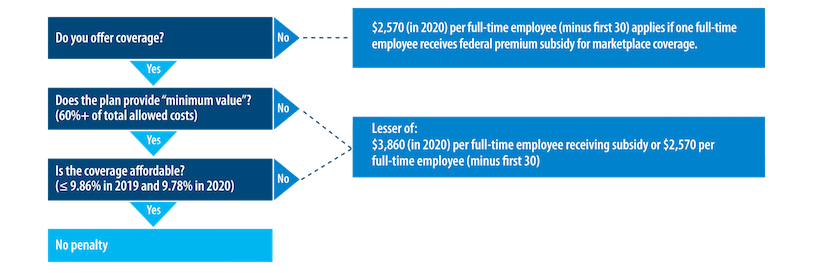
Overview of the coverage requirements and the penalties that apply if any full-time employee purchases coverage on the Marketplace and receives a federal premium subsidy.

Additional details on the Employer Mandate

Employer mandate coverage requirements since 2016

Employers with 50 or more full-time and/or FTE employees must offer affordable/minimum value medical coverage to their full-time employees and their dependents up to the end of the month in which they turn age 26, or they may be subject to penalties. The amount of the penalty depends on whether or not the employer offers coverage to at least 95% of its full-time employees and their dependents.

  • Employers who fail to offer coverage to at least 95% of full-time employees and dependents may be subject to a penalty of $2,320 per full-time employee minus the first 30.
  • Employers who offer coverage may still be subject to a penalty if the coverage is not affordable or does not provide minimum value. This penalty is the lesser of either $3,480 per full-time employee receiving a federal subsidy for coverage purchased on the Marketplace, or $2,320 per full-time employee minus the first 30.

Employers must treat all employees who average 30 hours a week as full-time employees.

Dependents include children up to age 26, excluding stepchildren and foster children. At least one medical plan option must offer coverage for children through the end of the month in which they reach age 26. Spouses are not considered dependents in the legislation, so employers are not required to offer coverage to spouses.

Examples of the requirement to cover 95% of full-time employees

Assume each employer has 1,000 full-time employees who work at least 30 hours per week.

  • Employer 1 currently offers medical coverage to all 1,000 and their dependents. The company is considered to offer coverage since it offers coverage to more than 95% of its full-time employees and their dependents.
  • Employer 2 currently offers medical coverage to 800 full-time employees and their dependents. The company will need to offer coverage to 150 more full-time employees and their dependents to meet the 95% requirement to be treated as offering coverage.
  • Employer 3 has 500 full-time, salaried employees who are offered coverage and 500 full-time hourly employees who are not offered coverage. The company will need to offer coverage to at least 450 hourly employees (and their dependents) to meet the 95% requirement to be treated as offering coverage.
  • Employer 4 offers coverage to 950 full-time employees and their dependents. Only 600 of those employees actually enroll in coverage. The company is compliant no matter how many employees actually enroll in affordable coverage that offers minimum value.
Determining how many full-time employees an employer has

The regulations allow various calculation methods for determining full-time equivalent status. Because these calculations can be complex, employers should consult with their legal counsel.

  • Full-time employees work an average of 30 hours per week or 130 hours per calendar month, including vacation and paid leaves of absence.
  • Part-time employees’ hours are used to determine the number of full-time equivalent employees for purposes of determining whether the employer mandate applies.
  • FTE employees are determined by taking the number of hours worked in a month by part-time employees, or those working fewer than 30 hours per week, and dividing by 120.
Counting part-time and seasonal employees

Here are some considerations to help determine how part-time and seasonal employees equate to full-time and FTE employees.

  • Only employees working in the United States are counted.
  • Volunteer workers for government and tax-exempt entities, such as firefighters and emergency responders, are not considered full-time employees.
  • Teachers and other education employees are considered full-time employees even if they don’t work full-time year-round.
  • Seasonal employees who typically work six months or less are not considered full-time employees. This includes retail workers employed exclusively during holiday seasons.
  • Schools with adjunct faculty may credit 21/4 hours of service per week for each hour of teaching or classroom time.
  • Hours worked by students in federal or state-sponsored work-study programs will not be counted in determining if they are full-time employees.
Waiting periods to become eligible for coverage

Employers may not impose enrollment waiting periods that exceed 90 days for all plans beginning on or after January 1, 2014. Shorter waiting periods are allowed. Coverage must begin no later than the 91st day after the hire date. All calendar days, including weekends and holidays, are counted in determining the 90-day period.

Plans subject to the employer mandate

U.S.-issued expatriate plans meet the employer mandate.

Effective July 16, 2014, the employer mandate no longer applies to insured plans issued in the U.S. territories (Puerto Rico, the U.S. Virgin Islands, Guam, American Samoa and the Northern Mariana Islands). A territory may enact a comparable provision under its own law.

Employer mandate reporting

All applicable large employers are required to file an annual report that ensures compliance with the employer mandate. The reporting will include information on all employees who were offered and accepted coverage, and the cost of that coverage on a month-by-month basis.

What happens if an employee receives subsidized coverage

Each year, public Marketplaces should send notices to employers that may owe a penalty for not complying with the employer mandate. These notices will alert employers if any of their employees received a subsidy through the Marketplace.

Employers that receive these notices will have 90 days to file an appeal if they believe the eligibility determination was made in error. It’s important that employers maintain documentation and records to provide proof of compliance with the employer mandate.

Read more about the employer notice process from the Centers for Medicare and Medicaid Services.

Employer mandate penalty amounts and processes

Examples of employer penalties
The employer does not offer coverage to full-time employees
The penalty is $2,320 per full-time employee, excluding the first 30 employees. This example shows how the penalty would be calculated.
Employer Trigger Penalty
500 full-time employees

No coverage offered

One employee purchases coverage on the Marketplace and is eligible for a federal premium subsidy $2,320 per full-time employee, minus the first 30 employees

500 – 30 = 470 employees

470 x $2,320 = $1,090,400 penalty

The employer offers coverage that does not meet the minimum value and affordability requirements

The penalty is the lesser of the two results, as shown in this example.

Employer Trigger Penalty
1,200 full-time employees

Employer offers coverage, but coverage is not affordable and/or doesn’t provide minimum value

The penalty is triggered if one employee purchases coverage on the Marketplace and receives a federal premium subsidy

250 employees purchase coverage on the Marketplace and are eligible for a subsidy

Lesser of $2,320 per full-time employee, minus the first 30 employees, OR $3,480 per full-time employee receiving a federal premium subsidy

1,170 x $2,320 = $2,714,400 penalty

250 x $3,480 = $870,000 penalty (lesser penalty applies)

Penalty assessment process

Here is a snapshot of the penalty assessment process:

Employer offers health coverage compliant with the employer mandate

  • The Marketplace should notify the employer if an employee receives subsidized coverage during this same plan year
  • Employer may gather facts for response or file an appeal within 90 days of Marketplace notification
Employer reports coverage offer and respective data during the applicable tax season
Marketplace reports Minimum Essential Coverage data on employees, including subsidy information
IRS sends Letter 226J, with an Employer Shared Responsibility Payment assessment based on the data they have processed

  • Employer sends Form 14764 (response to Letter 226J) with Form 14765 (lists employees receiving subsidized coverage) and any updated or corrected data to previously reported Forms 1095-C
IRS sends Notice 220J, confirming the final penalty amounts owed, which could state no amount is owed after final audit review.
How an employer will know if a penalty has been assessed

If an employee receives subsidized coverage, the employer should be notified by the public Marketplace. The employer will then be provided an opportunity to respond and appeal if the employee was offered coverage that meets the minimum value and affordability standards.

Once the IRS has received individual tax returns and employer reporting for a given calendar year, it may determine that an employer did not meet its employer mandate requirements and is subject to a financial penalty, known as the Employer Shared Responsibility Payment (ESRP). The IRS will send the employer an IRS Letter 226J.

How an employer can appeal a penalty assessment

Any employer who receives a 226J letter should take immediate action to respond to the IRS. The employer has 30 days to respond with documentation and corrected reporting data (if applicable). Doing this may help the employer reduce or eliminate the ESRP assessed.

After the employer responds with documentation of corrected data previously reported on the Forms 1095-C, the IRS will complete their review and send a Notice 220J to the employer. This notice confirms the final penalty amounts being charged, by month. The Notice 220J may also indicate that no penalty is being charged based on the IRS’s review of any data or documentation provided by the employer in response to the initial Letter 226J.

Read more about employers’ options on the IRS web page, Employer Shared Responsibility Payment Q&As, questions 55-58.

How penalties apply to companies with a common owner

Companies that have a common owner are combined for purposes of determining whether they are subject to the mandate. However, any penalties would be the responsibility of each individual company.

* Before January 2016, employers with 50-99 employees were not required to offer coverage, and employers with 100 or more complied if they offered coverage to at least 70% of their full-time or FTE employees.

Filed Under: Federal Regulations, Healthcare Regulations, Uncategorized

Final Regulations – 2021 Notice of Benefit and Payment Parameters

July 13, 2020

On May 7, 2020, the Centers for Medicare & Medicaid Services (CMS) issued final regulations and related guidance on a number of Affordable Care Act (ACA) provisions and related health care topics including out-of-pocket (OOP) maximums, prescription drug coupons and cost-sharing, Medical Loss Ratio (MLR) calculations, and Exchange updates and reforms. These regulations are generally effective for plan years beginning on and after Jan. 1, 2021.

2021 OOP maximums

The 2021 OOP maximums will increase to $8,550 for individual coverage and $17,100 for family coverage. These coverage limits apply to all non-grandfathered plans, regardless of size or funding type.

Prescription drug coupons

Beginning in 2021, plans are permitted, but not required, to include coupon amounts and other drug manufacturer direct assistance for prescription drugs as amounts paid toward a covered person’s annual OOP maximum, regardless of whether a generic equivalent is available. This applies to individual, small group, large group, and self-funded plans, to the extent permitted by state laws.

Medical Loss Ratio

Beginning with the 2022 MLR reporting year (i.e., MLR reports filed in 2023), issuers must report expenses of functions outsourced to, or services provided by, other entities consistently with issuers’ non-outsourced expenses. It also requires issuers to deduct prescription drug rebates and price concessions from MLR incurred claims. These rebates and price concessions must be deducted not only when received by the issuer, but also when received and retained by an entity that provides pharmacy benefit management services to the issuer.

Exchange regulations

The final rule includes a number of provisions that impact the Health Insurance Exchanges, including:

  • Maintain user fees from the 2020 plan year for Federally-facilitated Exchanges and State-based Exchanges on the Federal platform, 3.0% and 2.5% of total monthly premiums, respectively;
  • Finalize how Qualified Health Plan (QHP) issuers could voluntarily incorporate value-based insurance design principles into their QHPs;
  • Exchange eligibility enrollment and termination requirements;
  • Establish quality-rating information-display standards for Exchanges; and
  • Finalize changes to the risk adjustment program for insurers with high-cost enrollees.

The final rule also makes improvements, some beginning in January 2022, to Special Enrollment Period (SEP) rules.

Review the information at these links for additional details:

  • Read the Final Regulations [PDF]
  • Read the HHS Fact Sheet [PDF]

Filed Under: Affordable Care Act, Healthcare Regulations

Updates -Three ACA Taxes Repealed and 5th Circuit Decision in Two Major Events This Week

July 13, 2020

The week of Dec. 16, both chambers of Congress passed two year-end spending agreements to fund the federal government until Sept. 30, 2020 (H.R. 1158 and H.R. 1865). President Trump is expected to sign them into law before the Dec. 20 funding deadline. One of the agreements, H.R. 1865, the Further Consolidated Appropriations Act of 2020, included a full repeal of three taxes originally imposed by the Affordable Care Act (ACA): the 40% Excise Tax on employer-sponsored coverage (a.k.a. “Cadillac Tax”), the Health Insurance Industry Fee (a.k.a. the Health Insurer Tax), and the Medical Device Tax. Separately, on Dec. 18, the United States Court of Appeals for the Fifth Circuit ruled the ACA’s individual mandate is unconstitutional, but it did not invalidate the rest of the law. As a result, the rest of the law remains in effect. See below for more details.

Cadillac Tax

The Cadillac Tax would have imposed a 40% excise tax on coverage in excess of certain thresholds. When originally enacted in the ACA, the thresholds were $10,200 for self-only and $27,500 for family coverage with a 2018 effective date. The Cadillac Tax was delayed multiple times since passage of the ACA, and is now fully repealed, meaning it no longer exists and will never take effect.

Many employers, unions, insurers and industry groups have opposed the tax based on concerns around administrative and financial burdens for employers and adverse outcomes for employees.

Health Insurer Tax

H.R. 1865 also fully repeals the Health Insurer Tax, beginning in 2021. The $8 billion fee was implemented in 2014 and continued to increase each year. The fee only applied to insured business, including insured Medicare plans, based on each insurer’s share of the taxable health insurance premium base.

Due to the adverse impact on health insurance premiums, the fee was suspended in 2017 and 2019. It is important to note that the fee will be in effect for 2020 as no suspension was granted for that year; then, it will be repealed effective 2021.

Medical Device Tax

The Medical Device Tax imposed a 2.3% excise tax on U.S. medical device revenues. The tax was in effect over 2013-2015, and was suspended from 2016-2019. H.R. 1865 fully repeals the tax, effective Dec. 31, 2019.

Other notable items passed in the spending agreements include: legislation requiring the Administration to maintain certain policies (e.g., “silver loading”) for the individual Exchange markets to ensure consumers do not experience any disruptions for plan year 2021; legislation to prevent brand drug manufacturers from blocking access to samples of their products for generic drug development (a.k.a. the Creating and Restoring Equal Access to Equivalent Samples [CREATES] Act); and legislation to fund several expiring health programs until May 22, 2020. Read the final two-year spending package [PDF] for more details about these and other spending agreements.

Federal Appeals Court Ruling in Texas v. United States

A panel of the United States Court of Appeals for the Fifth Circuit ruled the ACA’s individual mandate is unconstitutional Wednesday. The court upheld the district court’s determination that the individual mandate is unconstitutional because it is no longer a tax with the zeroed-out penalty. In the district court ruling, Judge O’Connor further stated that because the mandate was essential to the law, it could not be severed (or separated) from the rest of the ACA, which meant the entire ACA was invalid. The appellate court did not resolve the severability issue or determine if any other provisions of the ACA should also be struck down. Instead, the panel remanded the case back to Judge O’Connor for further analysis of which other provisions of the ACA, if any, should be invalidated along with the individual mandate.

As a result of this new ruling, all remaining provisions of the law remain in effect – except for the newly repealed taxes listed above with their separate effective dates – while the legal process continues.

California Attorney General Xavier Becerra, who leads the 20 Democratic states that defended the ACA in this case, announced that the California Department of Justice is prepared to ask the U.S. Supreme Court to review the Fifth Circuit’s ruling. This is expected to be a long process and we will continue to keep you updated until there is a final resolution.

Filed Under: Affordable Care Act

CARES Act, COVID-19 Relief Package, Signed into Law

July 13, 2020

This law strengthens the Federal Government and Health Care System’s Response.

On March 27, 2020, President Trump signed the Coronavirus Aid, Relief, and Economic Security (CARES) Act into law. The $2 trillion package provides economic relief to individuals, health care providers, small businesses, and heavily affected sectors of the economy, and is intended to strengthen the federal government and health care system’s response to the COVID-19 pandemic. The bill passed the Senate unanimously on March 25 and passed the House on March 27 with an overwhelming voice vote.

Key economic provisions of the CARES Act include:

  • Individual Stimulus Payments: Provides a one-time $1,200 refundable tax credit for individuals ($2,400 for joint taxpayers), plus $500 per child under age 17. The payment phases out for those with adjusted gross incomes of $75,000 or more ($150,000 for joint taxpayers). The rebates would not be counted as taxable income for recipients.
  • $349 billion in Small Business Interruption Loans: Provides eight weeks of cash-flow assistance, from February 15, 2020, through June 30, 2020, for qualifying businesses (fewer than 500 employees, or the small business size standard associated with that industry, includes franchises, sole-proprietors, and self-employed), available through existing SBA-certified lenders. Details and instructions are expected to be released by the Small Business Administration in the next 15 days.
  • Allowable uses include costs related to group health care benefits and insurance premiums, and loan amounts are forgiven for amounts paid towards payroll costs, including payment of group health benefits.
  • $500 billion in Treasury Loans to Severely Stressed Sectors of the Economy: Provides the Treasury Secretary $500 billion to make loans, loan guarantees, and other investments to support heavily affected industries, States, and municipalities for direct or indirect losses as a result of the coronavirus. Details and instructions are expected to be released by the Treasury in the next 10 days.
  • Unemployment Insurance and Grants: Creates a temporary Pandemic Unemployment Assistance program through December 31, 2020, to provide payment to those not traditionally eligible for unemployment benefits. Provides up to $600/week to each recipient of unemployment insurance or Pandemic Unemployment Assistance for up to four months.
  • Short-Term Compensation Programs: Provides $100 million in federal grant funding to support short-term compensation arrangements, where employers can reduce employee hours instead of laying off workers and impacted employees will receive a prorated unemployment benefit.
  • Payroll Tax Credit: For qualifying employers whose operations were fully or partially suspended, or whose gross receipts declined by more than 50%, provides a fully refundable payroll tax credit for 50% of wages paid up to $10,000 during the public health emergency.

Healthcare-related provisions include:

  • Aid to Health Care Institutions: $100 billion available to eligible health care providers and hospitals for healthcare-related expenses and lost revenues directly attributable to COVID-19. Eligible entities include public entities, Medicare or Medicaid suppliers and providers, and for-profit and not-for-profit entities as specified by the Secretary of Health and Human Services (HHS) that provide diagnoses, testing, and care for individuals with possible or confirmed cases of COVID-19.
  • COVID-19 Vaccine Coverage: Requires commercial insurers to cover any qualifying coronavirus preventive service (i.e., vaccines) defined by the U.S. Preventive Services Task Force. Requires Medicare and Medicare Advantage organizations to cover any COVID-19 vaccines with no cost-sharing.
  • COVID-19 Testing Coverage: Clarifies existing law requiring all COVID-19 testing to be covered by group health plans and individual market issuers without cost-sharing, including those tests without an emergency use authorization by the Food and Drug Administration (FDA).
  • In early March, Cigna voluntarily announced it would waive cost-sharing for COVID-19 testing and office visits related to testing for our members through May 31.
  • Payment of COVID Tests: Requires commercial insurers to pay either: (1) the rate specified in a contract between the provider and the insurer in effect before the public health emergency was declared, throughout the duration of the public health emergency; or (2) if there is no contract, a cash price posted on a public website by the provider, or the plan may negotiate a rate lower than the cash price. Imposes civil monetary penalties on providers that do not post the price on a public website.
  • 90-Day Fills and Refills: Requires Medicare Part D and Medicare Advantage plans to allow fills and refills of covered Part D drugs for up to 90-days during the public health emergency.
  • Telehealth Expansions: Provides $200 million to the Federal Communications Commission (FCC) to support the efforts of health care providers to provide telecommunication services, information services, and devices to enable telehealth services.
  • Telehealth and High-Deductible Health Plans (HDHPs): Establishes a safe harbor for HDHPs that provide benefits for telehealth and other remote care services before patients satisfy the applicable minimum deductible.
  • Over-the-Counter Medical Products and HDHPs: Allows patients to use health savings account (HSA) and flexible spending account (FSA) funds for over-the-counter medical products, including those needed for quarantine or social distancing, without a prescription from a physician.
  • Confidentiality and Disclosure of Records Covered by 42 CFR Part 2: Allows for additional care coordination by aligning 42 CFR Part 2 regulations, which govern the confidentiality of substance use disorder treatment records, with existing Health Insurance Portability and Accountability Act (HIPAA) privacy requirements, with initial patient consent.
  • Temporary Moratorium of Medicare Sequestration: Temporarily lifts the 2% Medicare sequester from May 1 through December 31, 2020.

The bill can be read in full here.

Filed Under: COVID-19

Colorado Passes Legislation Requiring Paid Sick Leave

July 13, 2020

Last week, the Colorado legislature passed SB20-205, the Healthy Families and Workplaces Act (HFWA). This legislation will require all Colorado employers to provide three types of paid sick leave:

  1. COVID-19 emergency paid sick leave
  2. Paid sick and safe time
  3. Public health emergency paid sick leave

Governor Polis is expected to sign the legislation into law. It will take effect immediately, but certain provisions will not take effect until 2021 or 2022, depending on the size of the employer. All three paid leave programs under the HWFA will apply to all private employers that have an employee who works in Colorado.

For the purposes of this legislation, an “employee” is any person, including a migratory laborer, performing labor or services for an employer’s benefit. The law does not apply to independent contractors or to employees subject to the federal Railroad Unemployment Insurance Act. The HWFA does not apply to employees covered by a CBA in effect on the law’s effective date if the CBA provides for equivalent or more generous paid sick leave for employees the CBA covers.

COVID-19 Emergency Paid Sick Leave (CO-EPSL)

  • This benefit will be in effect whenever the Governor signs the bill into law through December 31, 2020.
  • Employers with more than 500 or more employees will now be required to comply with the EPSLA but they will not receive any tax relief.
  • Employers with 499 or fewer employees that federal law allows excluding certain employees from the EPSLA will need to comply as well.

Paid Sick & Safe Time (PSST)

The PSST mandate will initially apply to employers with 16 or more employees beginning on January 1, 2021, and then apply to all employers on January 1, 2022. Among some of the guidelines of this benefit include but is not limited to:

  • Employees must accrue at least one hour of PSST for every 30 hours they work, up to a maximum of 48 hours per year.
  • Alternatively, at the beginning of the year, employers can provide an amount of PSST that meets or exceeds the law’s requirements. Unlike many paid sick and safe time laws, the HWFA does not address whether frontloading relieves employers of their carry-over obligation, so we hope the CDLE addresses this issue.
  • Generally, up to 48 hours of accrued, unused PSST hours carries forward to a subsequent year.
  • Employers with a paid leave policy are not required to provide additional paid sick leave to employees if they: 1) make available an amount of paid leave sufficient to meet the PSST, and 2) allow employees to use paid leave for the same purposes and under the same conditions as provided by the HWFA.
  • Employers must allow employees to use leave upon an employee’s request. That request may be made orally, in writing, electronically, or by any other means acceptable to the employer. An employer may provide a written policy that contains reasonable procedures for employees to provide notice but cannot deny leave based on non-compliance with the policy.
  • Employers must pay leave at the same hourly rate or salary and with the same benefits including health care benefits as the employee normally earns during hours worked.
  • Employers need not cash out unused PSST when employment ends.

Public Health Emergency Leave (PHEL)

In the event of a Public emergency, employers must supplement an employee’s PSST to ensure the employee may take the following amounts of leave:

  • For employees who normally work 40 hours or more per week: at least 80 hours
  • For employees who normally work fewer than 40 hours in a week: at least the greater of either the amount of time the employee is scheduled to work in a 14-day period or the amount of time the employee actually works during an average 14-day period.

Other guidelines of this benefit include but are not limited to:

  • An employer may count an employee’s unused PSST toward the PHEL. Employees are eligible for PHEL only once during the entirety of a public health emergency.
  • An employee may use PHEL until four weeks after the official termination or suspension of the public health emergency.

Filed Under: COVID-19

  • « Previous Page
  • 1
  • …
  • 6
  • 7
  • 8
  • 9
  • 10
  • …
  • 16
  • Next Page »
Email Icon Email Us: Cher@gogetcovered.com

Search GoGetCovered.com

Our Insurance Providers:

Join us on social media


Recent Updates

  • Pharmacy forces shaping employer benefit strategies in 2026
  • ONE BIG BEAUTIFUL BILL ACT – Here’s what you need to know
  • 2025 Contribution Limits – Updates
  • IRS Contribution Limits (What’s changing in January 2025)
  • IRS Contribution Limits (2024 Update)
  • IRS Releases 2024 Limits for HSAs, EBHRAs & HDHPs
  • 2022 Year-End Compliance Review
  • IRS Regulations Fix the ACA’s Family Glitch as of 2023
  • Health Plan Prescription Drug Reporting Mandate (RxDC)
  • IRS Releases 2023 Limits for Flexible Spending Accounts (FSA), Health Savings Accounts (HSA) and Commuter Benefits

site map · privacy policy · Copyright © 2026 · Cheryl Golenda Insurance Agency Inc. · theme by StudioPress · customized by Intent Design Studio · hosted by BlueHost · Log in

This website uses cookies to improve your experience. We'll assume you're ok with this, but you can opt-out if you wish. Cookie settingsACCEPT
Privacy & Cookies Policy

Privacy Overview

This website uses cookies to improve your experience while you navigate through the website. Out of these cookies, the cookies that are categorized as necessary are stored on your browser as they are as essential for the working of basic functionalities of the website. We also use third-party cookies that help us analyze and understand how you use this website. These cookies will be stored in your browser only with your consent. You also have the option to opt-out of these cookies. But opting out of some of these cookies may have an effect on your browsing experience.
Necessary
Always Enabled
Necessary cookies are absolutely essential for the website to function properly. This category only includes cookies that ensures basic functionalities and security features of the website. These cookies do not store any personal information.
SAVE & ACCEPT