• Home
  • What We Do
  • About
  • Employee Benefits
  • Individual Info
  • Health Care Reform
  • Kudos
  • Blog
  • Contact

GoGetCovered.com

We help make getting covered easier! - Insurance for Businesses and Individuals

GoGetCovered: Insurance for Businesses and Individuals
  • Group Health
    • Large Group Health Insurance
    • Small Group Health Insurance
  • Group Life
  • Group Dental
  • Vision
  • Short Term
  • Disability
  • Individual/Family
  • Children
  • Travel

Final Rule Released on HRAs

June 18, 2019

On June 13, 2019, the Departments of Labor, Health & Human Services and Treasury released final rules concerning Health Reimbursement Arrangements (HRAs). The 497-page rule includes the creation of two new types of HRAs, the “Individual Coverage HRA” and the “Excepted Benefit HRA.”

Advantages of the Individual Coverage HRA include, but are not limited to:

  • Funds can be used to reimburse the employee’s premiums for an individual health insurance policy.
  • Reimbursements made to employees do not count towards the employee’s taxable wages.
  • The employer can choose to roll-over unused amounts into the following year.
  • Coverage can be offered to different classes of employees (e.g.; full-time, part-time, seasonal, salaried, hourly)
  • An offer of the Individual Coverage HRA represents an “offer of coverage” under the employer mandate, however, contributions must meet affordability guidelines. The IRS will release further guidelines regarding this later.

The Individual Coverage HRA also comes with restrictions and regulations including but not limited to:

  • An offer of an Individual Coverage HRA cannot be made to any employee that is offered a traditional group health plan.
  • If an offer of coverage is made to a class of employees, there is a minimum class size that is required. Size is typically 10% of that specific class of employees. For example, if an employer has 200 employees, a minimum of 20 employees would have to be in a specified class.
  • Contributions can be in any amount that the employer chooses, but contributions must be consistent for all employees in a specified class.
  • The employer must provide notice of the Individual Coverage HRA to employees.
  • The employer must be able to substantiate that the employee is enrolled in an individual plan or Medicare (model notices are available).
  • The employer must notify employees on an annual basis that the individual health insurance is NOT subject to ERISA.

The final rule also created the “Excepted Benefit HRA” which, starting in January of 2020, will permit employers to finance additional medical care. Employees can use the HRA without having to be enrolled in the group’s traditional health plan.

The requirements associated with the “Excepted Benefit HRA” include, but are not limited to:

  • The annual contribution is capped at $1,800.
  • It must be offered in conjunction with a group health plan, but there is no requirement for the employee to enroll in that plan.
  • The “Excepted Benefit HRA” cannot be used to fund group health or Medicare premiums.
  • It can fund premiums for dental, vision, or short-term limited duration insurance.

Employers who want to offer the “Individual Coverage HRA” for January 1, 2020, can do so but employees will need to enroll in an individual plan during the 2019 open enrollment period (November 1, 2019 – December 15, 2019).

Filed Under: Healthcare Regulations

2019 ACA and HSA Inflation Adjustment

December 28, 2018

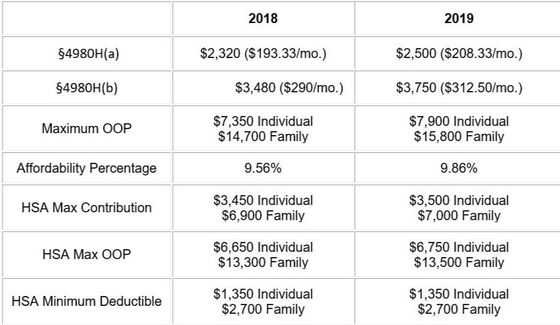
Earlier this year the IRS announced its 2019 inflation adjustment indexing for a number of ACA  provisions such as the employer shared-responsibility penalty affordability percentage (employee contribution limit that determines employer penalty), and Maximum out of pocket limits.

The two shared-responsibility penalties are for when employers fail to meet the minimum essential coverage (4980H(a)) and minimum value and affordability (4980H(b)). The section 4980H(a) penalty may be assessed when an ALE (applicable large employer) does not offer minimum essential coverage to at least 95 percent of its full-time employees, and at least one full-time employee receives a premium tax credit. The section 4980H(b) penalty may be assessed if an ALE offers minimum essential coverage to at least 95 percent of its full-time employees, but at least one full-time employee receives a premium tax credit because the coverage offered was not considered affordable and/or did not provide minimum value.

Employers need to make sure that they don’t overlook the adjusted ACA cost-sharing limits as they could face sharp penalties under the ACA’s shared responsibility provisions. In addition to the ACA adjusted index, the IRS released the 2019 HSA inflation-adjusted contribution limits as well:

2019 ACA and HSA Inflation Adjustment chart

Filed Under: Affordable Care Act, Health Savings Accounts

CO Senator Michael Bennet’s new idea to fix US Health Insurance: “Medicare X”

December 24, 2018

Bennett introduced the idea last week at the Colorado Health Institute’s annual Hot Issues in Health conference.

On the political spectrum of health-policy ideas, Medicare-X sits somewhere in the middle – a more moderate and incremental approach than the single-payer plans many of his fellow Democrats have been endorsing, but with plenty of federal involvement to attract attention from Republicans skeptical of government meddling in the marketplace.

Medicare-X is a basic buy-in plan for government health care coverage – a “public option”. People of any age shopping for their own health insurance would have the choice of buying insurance plans from private companies or, instead, buying into coverage through Medicare. (Medicare is normally the government health insurance program for those age 65 and older.)

http://colorado.hcbusinessnews.com/?p=18961

Filed Under: Colorado health and insurance resources, Federal Regulations

Safe Injection Facility Pilot Program Could Come to Denver

December 24, 2018

Denver has taken another step toward being the first U.S. city with a supervised site for illicit drug users to inject.aThe City Council passed an ordinance Monday night in support of a single facility pilot program for two years. The bill is sponsored by Councilman Albus Brooks.

The safe space idea would provide trained professionals and clean needles with an eye toward overdose and preventable disease intervention.

More than 1,000 people died from drug overdose in Colorado in 2017. A record 201 people died in Denver. Four years ago, Joelle Fairchild’s son, Tony, was among the overdose fatalities. He was found on the Cherry Creek Trail in Denver. Fairchild said a “supervised use site could have saved his life.”

The first step in support of a supervised drug use site came at a Nov. 7, Denver Safety, Housing, Education and Homelessness Committee public hearing.

At that hearing, people with histories of IV drug use, social workers, doctors and parents urged the council to approve supervised use facilities. Dr. Donald Stader, an emergency physician at Swedish Medical Center in Denver and representative of the American College of Emergency Physicians, pointed to research and the cost that taxpayers endure to treat cases of hepatitis and HIV.

He called it “not only the scientifically sound thing to do, but it is the moral thing for each one of you to do.”

Once the site is open, users could come in with their own drugs. The facility’s staff would be on site with overdose antidote naloxone, safe injection education and referrals to addiction treatment.

Lisa Raville of the Harm Reduction Action Center sees the possible pilot site as an extension of Denver’s flourishing needle exchange program. The center began providing sterile injection supplies in 2012.

In the last six years, the organization has given 52,000 referrals to testing, mental health support and substance abuse help centers. Raville said the safe injection site would help recovery programs meet drug addicts where they are.

“I can’t get them into treatment if they’re not alive,” she said.

Several cities around the country have considered safe injection sites as a way to cut down on overdose deaths. California sent a law to Gov. Jerry Brown to allow a site in San Francisco, but he vetoed it. Colorado’s potential pilot program is still contingent on the state legislature’s approval of such sites.

A bill to do that failed in the 2018 session.

While there are still implementation and legal hurdles to clear, Denver Mayor Michael Hancock said the City Council bill approved Monday has his full support and he will sign it.

“Like cities across the country, Denver is seeing significant numbers of people dying each year of drug overdoses,” Hancock said in a news release Tuesday. “I applaud Councilman Brooks for looking for innovative answers.”

Opponents to the program argue it will encourage drug use and bring crime to the site’s neighborhood.

The council said there will be opportunities for residents to give input about the possible location.

“It’s not the path I think the city ought to be taking,” said Councilman Kevin Flynn, who voted against the ordinance Monday. “To establish a designated area where dangerous illegal drugs, heroin, can be consumed.”

Flynn noted he would be in favor of the bill if it included a more “aggressive path toward treatment.”

Councilman Paul Lopez disagreed and argued addicts will use dangerous drugs regardless.

“You’re not enabling,” he said. “You’re being there as a supervisor to make sure they aren’t killing themselves. It’s not supervised injection sites replacing treatment. This is just another tool for a society that still doesn’t know how to address addiction.”

Filed Under: Colorado health and insurance resources

Interesting Facts: 2017 Health Insurance Reports from CO Division of Insurance

December 24, 2018

The Colorado Division of Insurance (DOI) has released its 2017 Health Insurance Cost Report. This annual report details the health insurance market in Colorado, including the trends in the individual and group markets, the factors that drive premiums, and the financial status of health insurers.

Highlights from the 2017 report include the following:

  • Average monthly premiums in Colorado across individual, small group (for small employers with 2 – 100 employees) and large group health plans (for employers with 100+ employees) ranged from $331 to $428.
  • The average health insurance deductible in Colorado was $1,951 for single coverage and $3,721 for family coverage.
  • More than half of all Coloradans received their health insurance from an employer. For this group, those with family coverage paid 27 percent of the total premium, while those just covering themselves paid 21 percent of the premium (employers paid the remaining portion of the premium).
  • Approximately 44 percent of private-sector employers in Colorado offered health insurance to their employees.
  • As was the case in 2016, 86 percent of the premiums collected for health insurance in Colorado went directly to the cost of paying for healthcare services.
  • Of the 425 health insurers in Colorado (many of which provide coverage other than major medical insurance, such as dental or vision insurance), the top 10 largest insurers accounted for 75 percent of the market.

The report can be found on the DOI’s page for “Insurance Brochures, Fact Sheets and Reports” – click on “Health Insurance Reports” under “Reports by DOI,” and on the next page, click “Health Insurance Cost Reports.”

Filed Under: Colorado health and insurance resources

  • « Previous Page
  • 1
  • …
  • 7
  • 8
  • 9
  • 10
  • 11
  • …
  • 16
  • Next Page »
Email Icon Email Us: Cher@gogetcovered.com

Search GoGetCovered.com

Our Insurance Providers:

Join us on social media


Recent Updates

  • ONE BIG BEAUTIFUL BILL ACT – Here’s what you need to know
  • 2025 Contribution Limits – Updates
  • IRS Contribution Limits (What’s changing in January 2025)
  • IRS Contribution Limits (2024 Update)
  • IRS Releases 2024 Limits for HSAs, EBHRAs & HDHPs
  • 2022 Year-End Compliance Review
  • IRS Regulations Fix the ACA’s Family Glitch as of 2023
  • Health Plan Prescription Drug Reporting Mandate (RxDC)
  • IRS Releases 2023 Limits for Flexible Spending Accounts (FSA), Health Savings Accounts (HSA) and Commuter Benefits
  • Inflation Reduction Act to be Signed into Law, Includes Multiple Medicare Drug Pricing Reforms

site map · privacy policy · Copyright © 2026 · Cheryl Golenda Insurance Agency Inc. · theme by StudioPress · customized by Intent Design Studio · hosted by BlueHost · Log in

This website uses cookies to improve your experience. We'll assume you're ok with this, but you can opt-out if you wish. Cookie settingsACCEPT
Privacy & Cookies Policy

Privacy Overview

This website uses cookies to improve your experience while you navigate through the website. Out of these cookies, the cookies that are categorized as necessary are stored on your browser as they are as essential for the working of basic functionalities of the website. We also use third-party cookies that help us analyze and understand how you use this website. These cookies will be stored in your browser only with your consent. You also have the option to opt-out of these cookies. But opting out of some of these cookies may have an effect on your browsing experience.
Necessary
Always Enabled
Necessary cookies are absolutely essential for the website to function properly. This category only includes cookies that ensures basic functionalities and security features of the website. These cookies do not store any personal information.
SAVE & ACCEPT